

Salesforce Employees React to Leadership and Culture Clash

Introduction: Salesforce Employees React
Salesforce employees have voiced significant concerns over leadership decisions and cultural shifts, particularly highlighted in recent controversies and past integration challenges. These tensions, from acquisition rifts to tone-deaf remarks, reveal underlying frictions in a company long celebrated for its “Ohana” values.
Table of Contents
Historical Culture Clashes
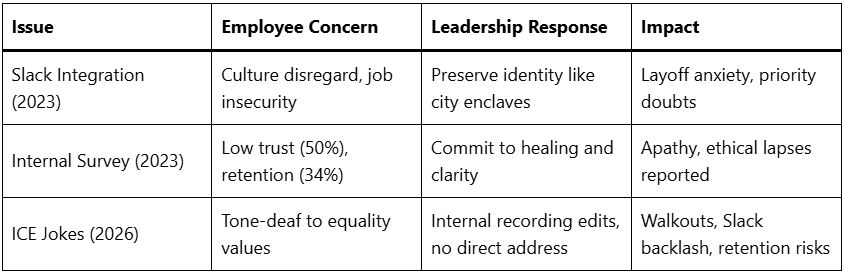
Slack’s 2023 acquisition by Salesforce exposed early cultural divides. Employees highlighted a “strong culture clash,” questioning how Slack’s innovative, agile ethos could survive within Salesforce’s larger, more bureaucratic structure. During an internal Q&A, staffers asked leaders like outgoing CEO Stewart Butterfield how to preserve core values amid layoffs and integration pressures.
A leaked survey of 57,000 Salesforce employees that year revealed “abysmal” results on trust and job security. Only 37% felt secure in their long-term future, 49% believed senior decisions aligned with company values, and just 34% thought top talent was retained effectively. HR head Brent Hyder acknowledged the pain but promised stability.
Recent ICE Joke Backlash
In February 2026, CEO Marc Benioff’s jokes about ICE agents during a leadership kickoff ignited fresh outrage. Internal Slack channels lit up with employee pushback, viewing the remarks as tone-deaf to Salesforce’s equality and inclusion principles. Staff walked out of sessions, and scolding emails followed, amplifying perceptions of eroded psychological safety.
This incident ties into broader anxieties about leadership accountability. Employees see it as symptomatic of a drift from “Ohana” ideals, impacting morale, retention, and even customer trust in Salesforce implementations. LinkedIn discussions framed it as a governance wake-up call for tech firms.
Leadership Responses and Employee Sentiment
Past responses, like Butterfield’s optimistic analogy of ethnic enclaves preserving identity, aimed to reassure but fell short amid 10% companywide layoffs. Recent events demand more than platitudes; staff craves action on ethics and alignment.
Surveys and leaks show patterns: low trust in management (50% climate of trust), apathy (88% willing to go the extra), and ethics flags (13% observed misconduct). For Salesforce professionals, this underscores culture’s role in productivity beyond features; people drive ROI.
Implications for Salesforce Culture
These clashes highlight risks in scaling: acquisitions dilute subcultures, while leadership missteps erode values. Employees push for transparency on priorities, like Slack’s strategic role post-layoffs.
Path Forward for Unity
To rebuild, leaders must prioritize cultural governance alongside innovation. Regular pulse surveys, value-aligned decisions, and inclusive forums could bridge gaps. Employees remain invested but demand authenticity, turning clashes into catalysts for a stronger, unified Salesforce. This evolution matters for CRM leaders relying on motivated teams to deliver AI-driven growth.