

Salesforce Data Cloud 2026: The New Brain of the Customer 360
Introduction: Salesforce Data Cloud 2026
By 2026, customer expectations have fundamentally changed. Customers no longer see brands as separate marketing emails, sales calls, service tickets, or commerce transactions. They see one relationship. To meet this expectation, organizations need more than disconnected CRM tools or static customer profiles they need intelligence that can think, learn, and act in real time.
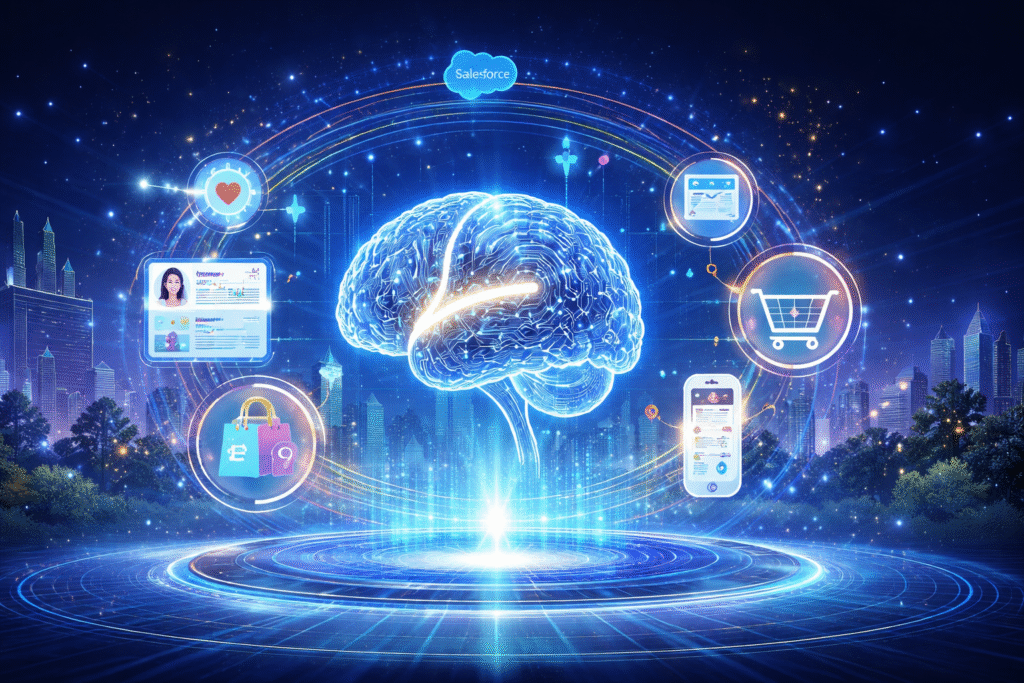
This is where Salesforce Data Cloud in 2026 emerges as a game-changer. No longer just a Customer Data Platform (CDP), Data Cloud has evolved into the central intelligence layer the brain of Customer 360, unifying enterprise data, AI, automation, and personalization into one cohesive system.
In 2026, Salesforce Data Cloud doesn’t just store customer data. It understands it, activates it, and powers decisions across the entire organization.
Table of Contents
Why Customer 360 Needs a “Brain” in 2026
The Limits of Traditional CRM
For years, CRM systems focused on recording interactions:
- Sales tracked opportunities
- Marketing tracked campaigns
- Service tracked cases
- Commerce tracked transactions
While useful, these systems operated largely in silos. Even when connected, they often relied on batch data updates and static reports. This approach can no longer keep up with:
- Real-time customer behavior
- AI-driven decision-making
- Personalized experiences across channels
From Data Silos to Unified Intelligence
In 2026, competitive advantage comes from how fast and how intelligently an organization can act on customer data. Customer 360 needs a “brain” that:
- Understands customers holistically
- Processes signals in real time
- Learns continuously through AI
- Coordinates actions across teams automatically
Salesforce Data Cloud becomes that brain transforming Customer 360 from a system of record into a system of intelligence.
What Salesforce Data Cloud Is in 2026
Evolution from CDP to Enterprise Data Engine
Originally positioned as a CDP, Salesforce Data Cloud in 2026 has expanded far beyond marketing use cases. It now functions as a real-time enterprise data engine that:
- Ingests structured and unstructured data from any source
- Harmonizes customer data across systems
- Activates insights across all Salesforce clouds
It supports not only customer data, but also product, interaction, behavioral, and operational data creating a complete enterprise view.
Hyperscale Data Processing and Zero-Copy Architecture
One of the most critical advancements is Data Cloud’s hyperscale architecture. In 2026, organizations manage data volumes that were unimaginable just a few years earlier. Data Cloud handles this scale by:
- Processing massive datasets with low latency
- Supporting real-time streaming data
- Using zero-copy architecture to avoid unnecessary data movement
This means data stays where it is, but becomes instantly usable across Salesforce faster, cheaper, and more secure.
Data Cloud as the Brain of Customer 360
Connecting Every Salesforce Cloud
In 2026, Salesforce Data Cloud acts as the connective tissue between:
Instead of each cloud working with partial data, all teams operate from the same real-time customer intelligence.
A sales rep sees the same customer truth as a service agent. A marketer activates the same signals that leadership uses for forecasting. The organization moves as one system.
Real-Time Identity Resolution
At the core of this intelligence is real-time identity resolution. Data Cloud continuously:
- Matches customer identities across devices, channels, and systems
- Resolves duplicates automatically
- Updates profiles as new data arrives
The result is a living customer profile not a static record, but a constantly evolving understanding of who the customer is and what they need right now.
AI-Powered Intelligence
Fueling Predictive Insights
In 2026, AI is only as powerful as the data behind it. Salesforce Data Cloud provides:
- Clean, harmonized, trusted data
- Real-time context for predictions
- Historical depth for pattern recognition
This enables AI to predict:
- Customer intent
- Likelihood to buy or churn
- Next best action
- Product and content recommendations
AI insights move from dashboards into workflows, guiding decisions automatically.
Integration with Salesforce AI and Autonomous Agents
Salesforce’s AI capabilities in 2026 increasingly rely on autonomous agents systems that can take action with minimal human intervention. Data Cloud becomes the intelligence source that:
- Feeds agents real-time signals
- Provides customer context
- Ensures decisions are grounded in trusted data
The result is automation that feels intelligent, not robotic.
Real-Time Personalization at Scale
Event-Driven Experiences
Traditional personalization relied on predefined segments updated daily or weekly. In 2026, Data Cloud enables event-driven personalization, where experiences change instantly based on:
- Website behavior
- App usage
- Service interactions
- Purchase events
- IoT or connected device signals
Every customer action becomes an opportunity to respond in real time.
Hyper-Personalized Journeys
With Data Cloud, personalization moves beyond names and preferences. Organizations deliver:
- Context-aware messaging
- Dynamic offers based on behavior
- Personalized service responses
- AI-guided sales conversations
These journeys adapt continuously, creating experiences that feel relevant, timely, and human even at massive scale.
Cross-Team Business Impact
Marketing Teams
Marketers benefit from:
- Unified audiences across channels
- Real-time activation of customer signals
- AI-driven journey orchestration
- Higher engagement and conversion rates
Campaigns become adaptive systems rather than static plans.
Sales Teams
Sales teams gain:
- Predictive lead and opportunity scoring
- Real-time customer insights during conversations
- AI-recommended actions and messaging
- Better alignment with marketing and service
Sales becomes more proactive and data-driven.
Service Teams
Service organizations shift from reactive to proactive by:
- Identifying issues before customers complain
- Personalizing support experiences
- Using AI insights to resolve cases faster
- Reducing churn through early intervention
Leadership and Decision-Makers
Executives benefit from:
- A single source of truth
- Trusted, harmonized data
- Faster, more confident decision-making
- Clear visibility into customer health and business performance
Governance, Security, and Trust
Data Privacy and Compliance
As data usage increases, so does responsibility. In 2026, Salesforce Data Cloud emphasizes:
- Built-in data governance
- Consent and preference management
- Regional compliance support
- Secure data access controls
This ensures organizations can innovate without risking trust.
Ethical AI and Trusted Data
AI decisions are only as ethical as the data behind them. Data Cloud ensures:
- Transparency in data usage
- Bias reduction through cleaner datasets
- Explainable AI outcomes
- Alignment with organizational values
In a trust-driven economy, trusted data becomes a competitive advantage.
Use Cases in 2026
Predictive Sales Engagement
Sales teams use Data Cloud to:
- Identify high-intent buyers
- Time outreach perfectly
- Personalize conversations dynamically
- Increase win rates with AI-backed insights
Proactive Customer Support
Service organizations:
- Detect issues before they escalate
- Trigger automated resolutions
- Alert agents with full context
- Improve satisfaction while reducing costs
AI-Driven Marketing Orchestration
Marketing teams orchestrate:
- Cross-channel journeys in real time
- Personalized content at scale
- Automated experimentation and optimization
- Continuous learning through AI feedback loops
The Future Outlook: Beyond 2026
Redefining CRM Strategy
Salesforce Data Cloud reshapes CRM from a tool into an intelligent operating system for customer engagement. Beyond 2026, we can expect:
- Deeper AI autonomy
- More real-time decision-making
- Stronger alignment between humans and machines
- CRM that acts, not just informs
Toward the Autonomous Enterprise
Salesforce’s vision points toward an enterprise where:
- Data flows freely and securely
- AI handles routine decisions
- Humans focus on strategy and relationships
- Customer experiences are continuously optimized
Data Cloud is the foundation that makes this possible.
Conclusion
In 2026, Salesforce Data Cloud is no longer optional. It has become the central intelligence layer of Customer 360, powering how organizations understand, engage, and serve their customers. By unifying data, enabling real-time intelligence, fueling AI, and ensuring trust, Data Cloud acts as the brain that coordinates every customer interaction across the enterprise.
For organizations serious about digital transformation, customer experience, and AI-driven growth, Salesforce Data Cloud in 2026 is not just a platform it is the foundation of modern CRM and the key to staying competitive in a rapidly evolving business landscape.