

Salesforce Cuts Nearly 1000 Jobs Amid AI Restructuring and Exec Shakeup
Introduction: Salesforce Cuts Nearly 1000 Jobs
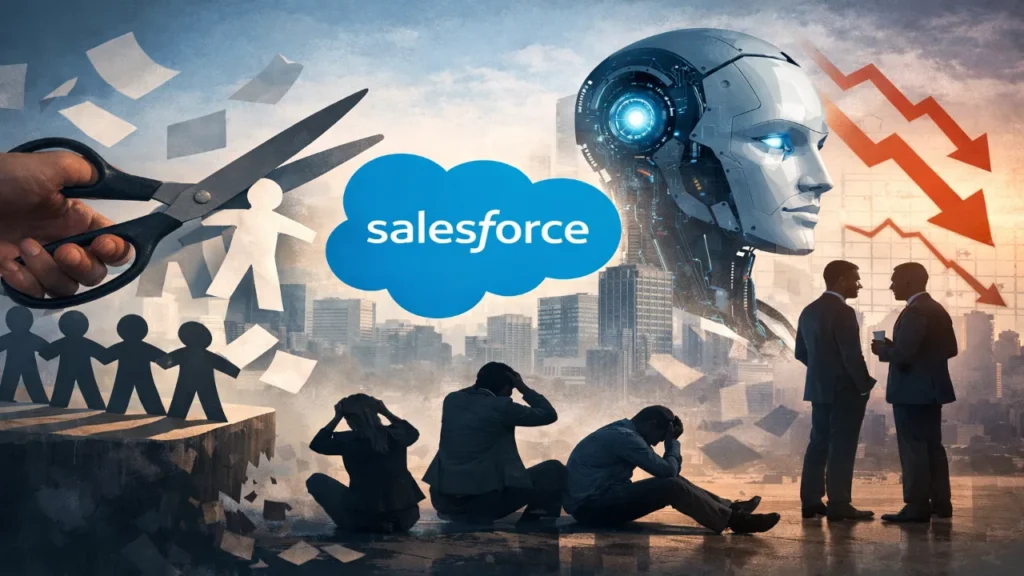
Salesforce, one of the world’s leading CRM and cloud software companies, has initiated another round of workforce reductions in early 2026, cutting nearly 1,000 jobs across a number of teams as part of a broader strategic shift toward artificial intelligence (AI) and executive restructuring.
These layoffs come amid increased emphasis on AI and automation, executive departures, and restructuring of business units, especially those tied to Salesforce’s AI products, such as Agentforce, even as the company continues to promote AI-driven growth.
Table of Contents
What Happened?
Reports from multiple industry sources confirm that Salesforce recently eliminated under 1,000 roles, primarily affecting teams across:
- Marketing and product management
- Data analytics
- Agentforce AI product group
- Heroku and related platforms
According to internal and external accounts, at least nine employees posted on LinkedIn that they were impacted by these layoffs, highlighting how this restructuring is affecting real people and roles within the company.
Although Salesforce did not publicly disclose exact figures, multiple reports describe this latest cut as “under 1,000” and linked to the company’s ongoing AI efforts and leadership changes.
Why It Matters
This isn’t Salesforce’s first layoff cycle. The company has been gradually adjusting headcount as it shifts toward AI automation, a trend seen across the tech sector. Part of this move is driven by Salesforce’s strategic focus on building and scaling generative AI tools, including Agentforce, which the company positions as a key growth driver for the future.
Salesforce has also seen significant executive turnover, with senior leaders departing in recent months. For example, the former EVP and GM of AI, Adam Evans, exited the company as part of this broader restructuring. In response, Salesforce reorganized its team, including integrating AI initiatives such as Agentforce and Slack under different leadership to better align with its AI-centric vision.
While the layoffs are smaller than some in tech’s recent wave, they still reflect broader industry trends: companies are slimming down traditional roles while reallocating talent toward AI-focused priorities and emerging business models.
AI’s Growing Role at Salesforce
A deeper context for these cuts can be found in Salesforce’s long-term embrace of artificial intelligence. CEO Marc Benioff has publicly stated that AI now performs a significant portion of the company’s work estimates ranging as high as 30–50% of internal tasks, highlighting automation’s expanding footprint within Salesforce’s operations.
This increasingly central use of AI has led to organizational shifts within Salesforce, including previous reductions in support and customer service roles, where AI bots now handle many routine interactions. Analysts have noted that this shift is part of Salesforce’s strategy to lower costs and increase operational efficiency, although such moves have triggered concern among industry observers about workforce displacement.
Executive Shakeup and Strategic Alignment
Part of Salesforce’s workforce changes are tied to leadership transitions at the top. Multiple executives have left the company in recent months, prompting internal realignment. Some teams have been brought under new leadership or merged into others to reflect Salesforce’s priority on AI and data-driven products.
This transition has led to speculation over how Salesforce plans to balance traditional enterprise software offerings with its growing suite of AI tools, including how AI products like Agentforce will be supported and scaled going forward.
Industry analysts point out that Salesforce’s relatively lean cuts compared with previous years indicate a more targeted approach: trimming roles that are less central to future AI-driven revenue, while bolstering teams focused on new AI services and product lines.
Market Dynamics and Broader Tech Trends
Salesforce’s layoffs are not happening in isolation. The tech industry at large has seen significant workforce reductions as companies adapt to:
- AI adoption and automation
- Cost optimization
- Post-pandemic rebalancing of talent
- Shifts in customer demand
In fact, in the first 40 days of 2026 alone, more than 30,000 tech jobs were cut globally among major companies, including Salesforce, Meta, Amazon, and others, reflecting a wider pattern of restructuring in the face of rapid technological change.
Some commentators argue that much of the current layoff activity is not solely driven by AI replacing jobs, but by a combination of over-hiring during pandemic growth, economic pressures, and the desire by companies to improve operating margins. Nonetheless, AI has become a convenient narrative for many of these decisions.
What’s Next for Salesforce?
For Salesforce, the focus now appears squarely on scaling AI solutions that can deliver competitive advantage and revenue growth. Products like Agentforce are central to this strategy, even as the company adjusts teams and leadership to support this vision.
The company’s ability to navigate this transition successfully will depend on how well it can balance innovation with customer satisfaction, employee morale, and broader organizational stability. Market watchers will be watching Salesforce’s next quarterly earnings closely for signs of how these shifts are affecting growth and profitability.
Conclusion
Salesforce’s decision to cut nearly 1,000 jobs in early 2026 is part of a broader transformation as the company embraces AI and undergoes executive changes. While these layoffs reflect the growing role of automation and AI efficiency goals, they are also situated within larger trends in the tech sector where companies are realigning workforces to better match evolving technological and economic conditions.
As Salesforce continues to invest in AI products like Agentforce, its ability to integrate innovation with a sustainable workforce strategy will be key to maintaining momentum in a rapidly changing industry landscape.