

Salesforce CRM vs HubSpot CRM: Which Is Better for You?
Introduction: Salesforce CRM vs HubSpot CRM
Selecting the right Customer Relationship Management (CRM) system is one of the most critical decisions a business can make in 2026. With AI-driven automation, hyper-personalized marketing, and increasingly complex sales processes, the right CRM can accelerate growth, improve customer engagement, and streamline operations. But with so many options available, the choice is not always straight forward.
Two of the most widely adopted CRM platforms are Salesforce CRM and HubSpot CRM. Both are leaders in the market, yet they serve different business needs, scales, and strategic goals. This in-depth comparison will help decision-makers whether in startups, SMBs, or large enterprises understand which platform is best suited for their organization.
Table of Contents
Why CRM Selection Matters in 2026
In 2026, CRM systems are no longer just digital address books. Modern CRMs serve as the central nervous system of a business, connecting sales, marketing, service, and operations. Choosing the wrong CRM can lead to:
- Poor adoption among teams
- Data silos and fragmented customer insights
- Wasted budget on underused features
- Missed opportunities for automation and AI-driven insights
Conversely, the right CRM enhances customer intelligence, accelerates revenue cycles, and provides a 360-degree view of customer interactions, all crucial in today’s competitive, AI-driven business environment.
Quick Overview: Salesforce CRM and HubSpot CRM
Salesforce CRM is widely recognized as the market-leading, enterprise-grade CRM platform. Known for its flexibility, scalability, and vast ecosystem, Salesforce can support businesses with highly complex sales processes and multi-department workflows.
HubSpot CRM is a cloud-based platform emphasizing ease of use, marketing automation, and rapid deployment. Its free tier and intuitive interface make it a favorite among startups and small-to-medium businesses (SMBs), especially those with marketing-heavy operations.
Who this comparison is for:
- Startups evaluating cost-effective, easy-to-deploy solutions
- SMBs looking for growth-friendly, scalable CRMs
- Enterprises requiring complex, customizable workflows and integrations
Side-by-Side Comparison
Core Features
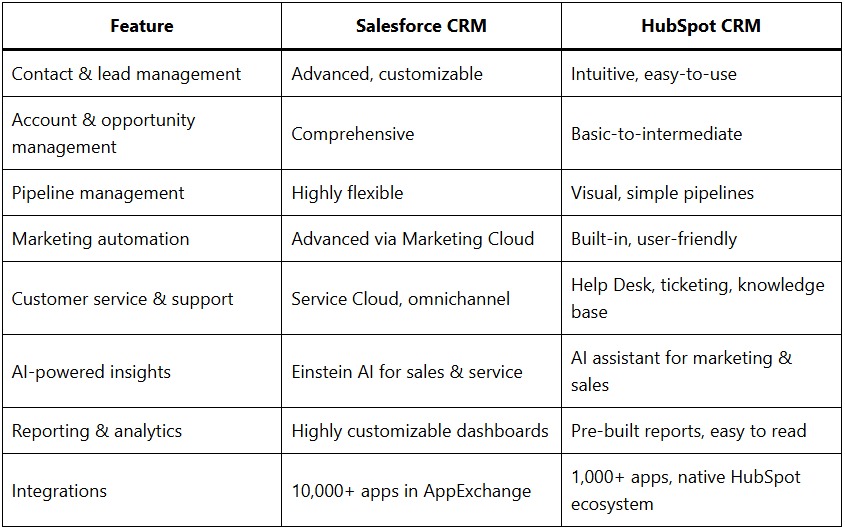
Key takeaway: Salesforce excels in complex, enterprise-level workflows, while HubSpot shines in ease of adoption and integrated marketing capabilities.
Ease of Use
- Salesforce CRM: Powerful but comes with a learning curve. Admin training is often required, and teams may need time to adapt.
- HubSpot CRM: Designed for simplicity. Non-technical users can onboard quickly without formal training.
2026 Insight: Ease of use directly impacts CRM adoption, which is critical as businesses increasingly rely on real-time AI insights and integrated workflows.
Customization & Scalability
- Salesforce CRM: Offers limitless customization through objects, workflows, automation, and APIs. Ideal for enterprises with complex processes.
- HubSpot CRM: Customization is improving but less extensive than Salesforce. Scales well for SMBs and growing startups, but enterprise-level customization can be limiting.
Marketing Automation
- Salesforce CRM: Integrates with Salesforce Marketing Cloud for multi-channel campaigns, predictive lead scoring, and AI-driven personalization.
- HubSpot CRM: Built-in marketing automation is user-friendly and includes email workflows, lead nurturing, and dynamic content.
Insight: Marketing-heavy teams benefit more from HubSpot’s out-of-the-box simplicity, whereas Salesforce supports enterprise-grade campaigns at scale.
Sales & Service Capabilities
- Salesforce CRM: Advanced pipeline management, forecasting, opportunity scoring, and omnichannel service capabilities.
- HubSpot CRM: Streamlined sales workflows, integrated CRM for sales and service, but less advanced forecasting.
Use Case: Complex B2B sales processes and multi-team collaboration favor Salesforce. Simple or SMB-level sales pipelines favor HubSpot.
AI & Automation Features
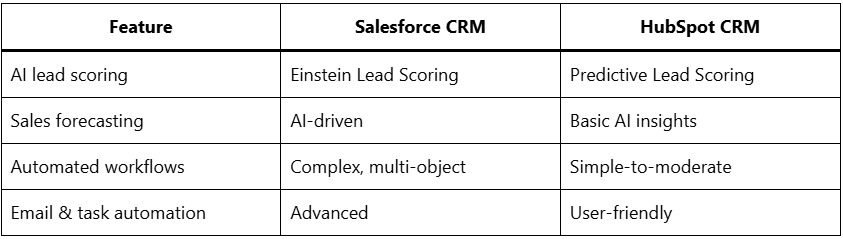
2026 trend: AI-driven recommendations and predictive insights are now standard. Salesforce offers enterprise-scale AI, while HubSpot provides quick, actionable AI tools for growing teams.
Integrations & Ecosystem
- Salesforce CRM: Extensive marketplace (AppExchange), including ERP, finance, analytics, and industry-specific apps.
- HubSpot CRM: Strong native ecosystem, easy integration with marketing and sales tools, fewer enterprise apps.
Reporting & Analytics
- Salesforce CRM: Custom dashboards, multi-source reporting, predictive analytics, and KPI tracking.
- HubSpot CRM: Pre-built dashboards, simple reporting for sales, marketing, and service teams. Customization limited in comparison.
Pricing & Total Cost of Ownership
- Salesforce CRM: Higher upfront and ongoing costs, often requiring implementation partners. Total cost includes licenses, training, customization, and add-ons.
- HubSpot CRM: Free tier for basic features, mid-tier paid plans are transparent. Lower TCO for startups and SMBs.
Insight: Budget-conscious startups and SMBs may find HubSpot more attractive, while enterprises see Salesforce as a strategic investment for complex operations.
Pros & Cons
Salesforce CRM
Pros:
- Highly customizable and scalable
- Advanced AI and analytics
- Robust enterprise-grade features
- Extensive integrations and ecosystem
- Strong multi-department workflows
Cons:
- Steep learning curve
- Higher cost of ownership
- Implementation may require specialized consultants
HubSpot CRM
Pros:
- Easy to use, minimal training required
- Strong marketing automation
- Transparent, flexible pricing
- Quick deployment and onboarding
- Ideal for small teams and startups
Cons:
- Limited enterprise customization
- Less advanced reporting
- May require third-party apps for complex workflows
Use-Case Based Comparison
Best CRM for Startups
HubSpot CRM: Free or low-cost tiers, easy adoption, integrated marketing tools, rapid deployment.
Best CRM for SMBs
HubSpot CRM: Scales with growing teams, easy marketing-sales alignment, lower TCO.
Best CRM for Enterprises
Salesforce CRM: Custom workflows, AI-driven insights, unlimited scalability.
Best CRM for Marketing-Heavy Teams
HubSpot CRM: Built-in automation, email workflows, and content tracking.
Best CRM for Complex Sales Processes
Salesforce CRM: Advanced forecasting, opportunity management, and multi-team collaboration.
Real-World Decision Guidance
When to Choose Salesforce CRM
- Complex sales cycles or multi-department workflows
- High customization and integration needs
- Enterprise-level security and compliance requirements
- Long-term investment in AI-driven insights
When to Choose HubSpot CRM
- Limited budget or small team
- Rapid deployment and minimal training required
- Marketing-focused growth strategy
- Desire for an all-in-one, easy-to-use platform
Common Buyer Mistakes
- Underestimating training and adoption time for Salesforce
- Overestimating HubSpot’s ability to handle highly complex enterprise workflows
- Choosing CRM solely based on price, not ROI
- Ignoring long-term scalability and integration needs
Key Takeaway:
There is no one-size-fits-all CRM. Choosing between Salesforce and HubSpot comes down to business complexity, budget, and growth strategy:
- Startups & SMBs: HubSpot CRM is ideal for rapid growth, marketing integration, and ease of use.
- Enterprises & complex sales operations: Salesforce CRM provides unmatched customization, scalability, and advanced analytics.
- Marketing-heavy teams: HubSpot offers out-of-the-box automation that drives engagement.
- Complex sales and multi-team collaboration: Salesforce ensures robust process control and forecasting.
Recommendation: Evaluate your team size, sales complexity, marketing needs, and long-term goals. For most startups and SMBs, HubSpot delivers quick wins and ROI. For enterprises with advanced requirements, Salesforce is the strategic choice for the next decade.