

Salesforce CEO Shifts AI Strategy as OpenAI Threat Looms
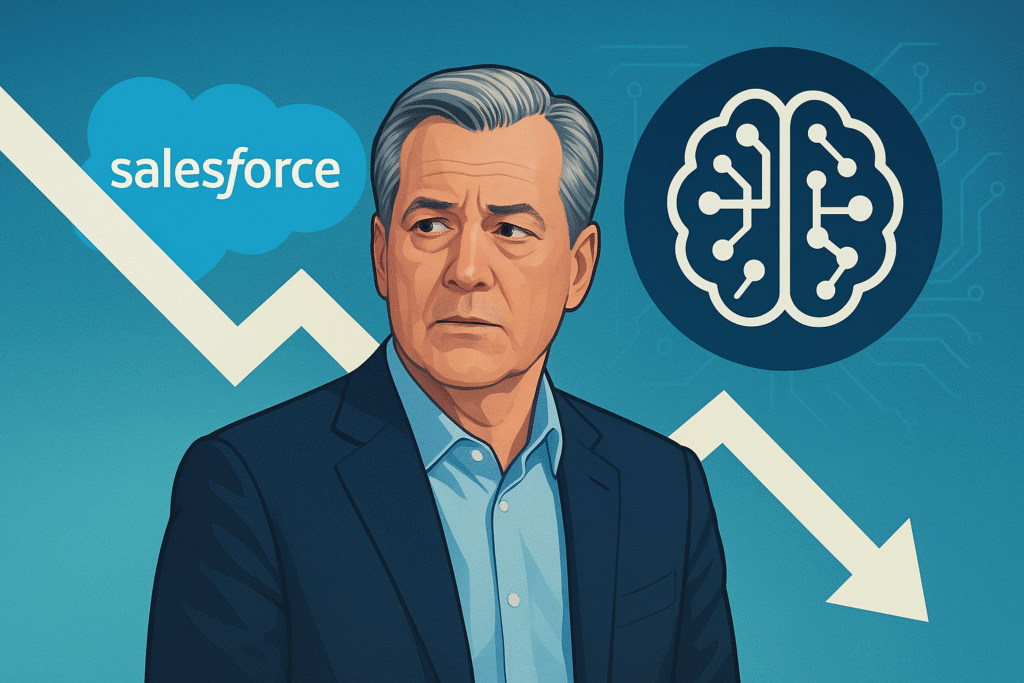
Introduction: Salesforce CEO Shifts AI Strategy
In an era where artificial intelligence is shaping the foundation of business innovation, Salesforce is undergoing a significant transformation in its AI strategy. As OpenAI and other emerging AI leaders continue to disrupt the enterprise software landscape, Salesforce CEO is taking decisive steps to ensure that the company is not only relevant but also at the forefront of the next wave of intelligent cloud computing.
Table of Contents
A Changing AI Landscape
The global AI ecosystem has evolved faster than most predicted. What started as simple automation and machine learning capabilities has now expanded into generative AI, real-time analytics, and autonomous digital agents. Salesforce finds itself at a critical crossroads with OpenAI’s models powering solutions across industries from marketing and sales to customer support.
OpenAI’s ChatGPT and enterprise integration set a new standard for conversational AI and intelligent automation. These tools empower businesses to interact directly with AI systems in ways traditional CRM could never have imagined. For Salesforce, this represents both a challenge and an opportunity: how to stay competitive in a market increasingly driven by generative intelligence.
Marc Benioff’s Strategic Pivot
Salesforce CEO Marc Benioff, long known for his forward-thinking approach, is now leading the company into a more AI-focused future. This transformation isn’t just about moving forward; it’s about redefining how AI lives in the Salesforce ecosystem.
Benioff has publicly emphasized that Salesforce’s strength lies in its trust-based data model and deep integration into business functions. However, they also acknowledge that the company must evolve quickly to compete with the agility and accessibility of new AI platforms. The goal is clear: make Salesforce the most reliable and customizable AI platform for enterprise users.
Under Benioff’s leadership, Salesforce is doubling down on the Einstein 1 platform, its generative AI layer that powers all Salesforce applications from Sales Cloud and Service Cloud to Marketing Cloud and Slack. The company aims to ensure that customers can securely use their own business data to train, deploy, and scale AI models without worrying about privacy breaches or data misuse, a growing concern in the age of generative AI.
The OpenAI Effect
OpenAI’s rapid expansion has created ripples throughout the tech industry. Businesses that once relied on third-party analytics tools or limited AI assistants now have access to models capable of reasoning, summarizing, coding, and creating human-like content. For enterprise software providers like Salesforce, this shift has forced a reevaluation of their core propositions.
OpenAI’s threat isn’t just technical; it’s strategic. OpenAI’s partnership with Microsoft, particularly its deep integration into tools like Microsoft Dynamics and Azure, is redefining what “AI-powered productivity” means for businesses. This combination creates a powerful alternative for enterprise customers who might otherwise rely on Salesforce for CRM and automation.
To combat this, Salesforce is reshaping its product roadmap. Instead of competing directly with OpenAI’s general-purpose models, Salesforce is focusing on domain-specific intelligence AI that understands customer data, workflows, and interactions at a granular level. This special focus may be Salesforce’s biggest advantage, as it builds trust and consistency where a typical AI context might lack.
Reimagining Einstein for the Generative Era
Salesforce’s Einstein AI has been part of its platform for many years, but the productivity revolution has changed expectations. The next evolution, Einstein Copilot, represents Salesforce’s answer to tools like ChatGPT and Microsoft Copilot. Embedded directly into Salesforce applications, Einstein Copilot helps users create reports, compose personalized emails, summarize conversations, and suggest next steps, all while leveraging company-owned data.
This move highlights Salesforce’s commitment to AI productivity within reliable boundaries. Unlike public AI tools that rely on open data sources, Einstein Copilot is grounded in the company’s own data ecosystem, ensuring privacy, compliance, and reliability.
Additionally, Salesforce is expanding the Einstein Trust Layer, an architecture designed to prevent sensitive business data from leaking into public AI models. This positions Salesforce as a leader in secure enterprise AI, which appeals to regulated industries such as finance, healthcare, and government.
Integrating Slack and Data Cloud
Another key part of Salesforce’s evolving AI strategy involves deep integration into its ecosystem, particularly with Slack and the data cloud. By combining generative AI with the real-time data processing capabilities of the data cloud, Salesforce can deliver personalized, predictive insights instantly.
For example, a sales rep using Slack can ask Einstein Copilot for a summary of recent client activity, get instant updates from multiple systems, and generate a tailored proposal all in one conversation. This kind of contextual intelligence is what differentiates Salesforce’s approach from typical AI platforms.
The merging of communication, collaboration, and data-driven automation illustrates Benioff’s vision of creating a “single source of truth” for AI in business operations.
Balancing Innovation and Trust
While many companies compete to use AI, Salesforce emphasizes ethical and responsible AI development. Benioff has been vocal about the importance of building trust as a foundational element of innovation. Salesforce’s AI principles focus on transparency, fairness, and accountability—values that resonate strongly in an era of deepfakes, misinformation, and growing concern over data privacy.
This trust-first strategy isn’t just a branding message; it’s a competitive moat. As AI tools become more powerful and accessible, businesses will turn to platforms that guarantee the safety and control of their information. For Salesforce, this is where its long-standing reputation in enterprise security becomes a key differentiator.
Looking Ahead: The AI Race Continues
Salesforce’s AI evolution isn’t happening in isolation. Tech giants like Google, Microsoft, and Amazon are expanding their AI capabilities at a rapid pace. OpenAI, with its GPT, is persistently exploring the limits of multimodal models. However, Salesforce’s distinct advantage lies in its deep domain knowledge and large customer base.
By embedding generative AI into every layer of its platform, Salesforce aims to make AI adoption seamless for millions of existing users. Whether it’s automating sales workflows, predicting customer behavior, or aiding in service resolution, AI will soon be as integral to Salesforce as CRM.
Key Takeaway:
The rise of OpenAI has reshaped the competitive landscape, forcing even giants like Salesforce to rethink their strategies. But Marc Benioff’s vision is clear: Salesforce won’t just be an AI participant—it intends to move forward with purpose, confidence, and innovation.
As the company moves toward a more productive and data-driven future, its approach reflects a broader truth about the AI age: technology alone is not enough. Trust, context, and responsible design will define the winners of the next decade, and Salesforce is firmly positioning itself in that competition.