

Salesforce Agentforce vs Traditional Automation: What’s the Difference?
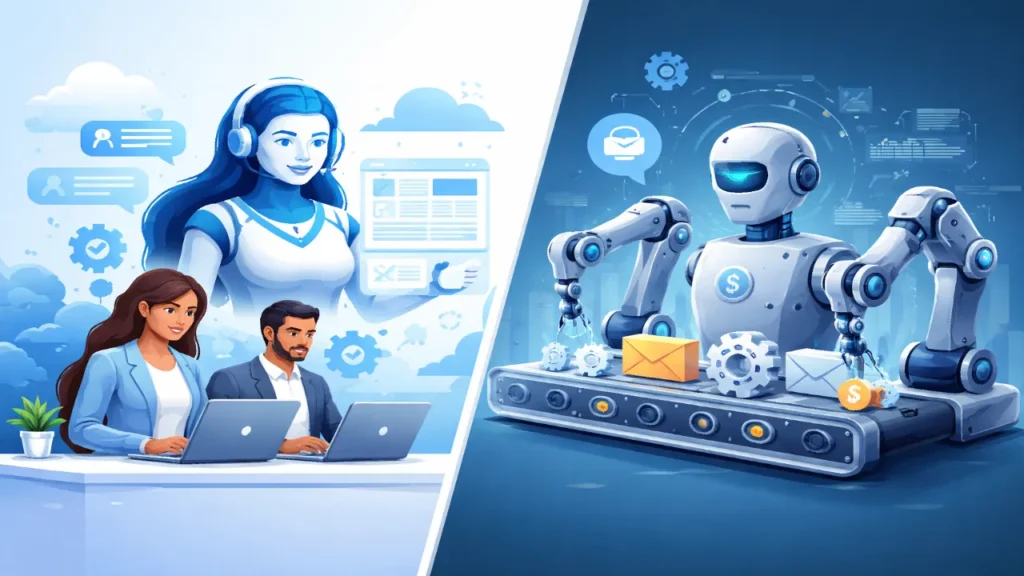
Introduction: Salesforce Agentforce vs Traditional Automation
As companies embrace the AI age, automation has evolved beyond mere rules and workflows. Modern organizations are now adopting intelligent AI-driven systems that can think, analyse, and take action independently. This shift is especially visible in the world of CRM with the rise of Salesforce Agentforce, a new approach to automation built on the powerful ecosystem of Salesforce.
For a long time, businesses leaned on familiar automation tools – workflows, triggers, and process builders – to make things run smoother. These tools certainly cut down on manual work, but they were still bound by rigid rules and needed human supervision, which limited their flexibility and responsiveness to changing business needs. This setup ultimately restricted their ability to adjust and respond quickly in today’s fast-paced world, leading to inefficiencies and missed opportunities for innovation and growth. Agentforce is introducing a fresh approach: autonomous AI agents. These agents are designed to understand the broader context, handle data, and execute a range of tasks with remarkable adaptability and effectiveness.
This article will examine the fundamental distinctions between Agentforce and conventional automation approaches. We’ll also take a closer look at the mechanics of each system and why AI-powered automation is becoming increasingly popular among businesses.
Table of Contents
Understanding Traditional Automation in CRM
Traditional automation refers to rule-based systems that perform predefined tasks automatically when certain conditions are met. Within Salesforce, these systems include tools such as workflows, process automation, and scheduled actions.
These automation mechanisms follow a simple logic structure:
If a condition happens → perform a predefined action.
For example:
- When a new lead is created, automatically assign it to a sales representative.
- When a case is marked urgent, notify the support manager.
- When a deal reaches a specific stage, send a follow-up email.
This approach has helped businesses streamline repetitive tasks and reduce manual errors, leading to increased efficiency and allowing employees to focus on more strategic activities. Traditional automation is reliable and predictable because every action is defined in advance.
However, it also comes with limitations.
Limitations of Traditional Automation
- Rule Dependency: Traditional automation relies heavily on fixed rules. The system’s ability to adapt is limited to situations that fit its existing rules.
- Limited Decision-Making: These systems cannot analyse complex data or make contextual decisions.
- High Maintenance: As business processes evolve, automation rules need frequent updates and maintenance.
- Lack of Intelligence: Traditional automation cannot understand customer intent, sentiment, or unstructured data.
As businesses deal with increasing data complexity and customer expectations, these limitations become more apparent, leading to challenges in effectively meeting customer needs and optimising operational efficiency.
What Is Salesforce Agent Force?
Salesforce Agentforce is the future of automation. Instead of relying solely on predefined rules, Agentforce introduces AI-powered autonomous agents that can analyse data, reason through situations, and take actions independently.
Agentforce combines multiple technologies within the Salesforce ecosystem, including AI models, enterprise data, and workflow systems. These AI agents are capable of engaging with customers, handling various tasks, and providing support to employees in different departments.
Agentforce distinguishes itself from conventional automation by prioritising intent-based automation over the more typical rule-based approach.
For example, instead of a fixed rule like
“Send an email when a case is created.”
Agentforce can analyse the case, understand its urgency, check the customer’s history, and determine the best possible response automatically.
This makes automation smarter, faster, and more adaptable.
How Agentforce Operates
Agentforce leverages AI agents, which are digital team members, and integrates them directly into Salesforce. These agents are built to analyze data, understand the business landscape, and execute tasks across multiple systems.
The process usually begins with a few key steps:
1. Data Understanding
Agentforce agents pull data from the CRM (Customer Relationship Management) ecosystem. This data encompasses customer records, interactions, service cases, and sales activities.
Moreover, they can analyze unstructured data, such as messages or conversations.
2. Contextual Examination
Employing artificial intelligence models, the system undertakes an analysis of the contextual factors inherent in each scenario. Rather than merely responding to direct instructions, it evaluates a spectrum of variables prior to initiating any action.
3. Intelligent Decision-Making
Agentforce agents are, at their core, problem solvers. They’re always evaluating situations, figuring out the best way to proceed.
This role could involve a range of tasks. It might include keeping existing records current, notifying coworkers of any changes, troubleshooting issues, or providing direct support to clients.
4. Autonomous Execution
Once the agent reaches a decision, it immediately begins executing tasks. It integrates smoothly with Salesforce workflows, applications, and other integrations, allowing for real-time data updates and streamlined processes that enhance overall efficiency.
Key Differences Between Agentforce and Traditional Automation
1. Rule-Based vs Intelligence-Based
Traditional automation depends entirely on predefined rules created by administrators.
Agentforce uses AI intelligence to interpret situations and determine actions dynamically.
This means Agentforce can handle unexpected scenarios more effectively, allowing it to adapt to changing conditions and make real-time decisions that traditional automation cannot.
2. Static Processes vs Adaptive Systems
Traditional automation follows rigid workflows. If the process changes, administrators must manually update automation rules.
Agentforce adapts to changing data and circumstances in real time, making it more flexible and scalable compared to traditional automation, which requires manual updates to rules when processes change.
3. Task Automation vs Decision Automation
Traditional automation focuses on completing repetitive tasks.
Agentforce goes a step further by supporting decision automation, where AI agents analyse data and choose the best action.
This significantly improves operational efficiency.
4. Human Dependency vs Autonomous Agents
Traditional automation still requires employees to manage complex scenarios and exceptions, which can lead to inefficiencies and increased workload.
Agentforce introduces autonomous AI agents that can manage tasks independently while still keeping humans in the loop when needed, ensuring that human oversight is maintained for critical decision-making and complex scenarios.
5. Limited Insights vs Data-Driven Intelligence
Traditional automation processes data but does not analyse patterns deeply.
Agentforce leverages advanced AI capabilities to detect trends, predict outcomes, and recommend actions.
This transforms automation from a passive system into an intelligent assistant.
Real-World Use Cases
Customer Service Automation
With traditional automation, customer support cases are routed using fixed rules.
Agentforce can analyse the customer’s request, understand intent, and automatically provide solutions or route the case to the most appropriate support agent.
This reduces response time and improves customer satisfaction.
Sales Process Optimization
Traditional automation might assign leads based on territory or simple conditions.
Agentforce can analyse lead behaviour, engagement history, and potential value to prioritise opportunities and recommend the best sales actions.
Marketing Personalization
Traditional marketing automation sends campaigns based on segmentation rules.
Agentforce can personalise messaging dynamically based on customer behaviour, preferences, and engagement patterns.
This leads to more effective marketing campaigns.
Workflow Optimization
Traditional automation executes predefined workflows.
Agentforce evaluates the entire workflow process and suggests improvements, helping organisations optimise operations continuously.
Benefits of Agentforce for Businesses
Increased Productivity
AI agents handle repetitive tasks and decision-making processes, allowing employees to focus on strategic activities.
Faster Customer Response
Agentforce can interact with customers instantly, improving response times and service quality.
Better Decision-Making
AI-powered analysis offers deeper understanding of customer behaviour and operational performance.
Scalable Automation
Agentforce can manage large volumes of interactions and processes without requiring constant rule updates.
Enhanced Customer Experience
By understanding context and intent, Agentforce enables more personalized and meaningful customer interactions.
When Traditional Automation Still Makes Sense
Despite the advantages of Agentforce, traditional automation still plays an important role.
For simple and predictable workflows, rule-based automation remains effective and straightforward to manage.
Examples include:
- Data updates
- Scheduled notifications
- Basic workflow approvals
- Simple record assignments
In many organisations, the best approach is a hybrid model, where traditional automation handles basic tasks while Agentforce manages complex decision-making processes.
The Future of Automation in Salesforce
Automation is evolving rapidly, and AI-powered systems are becoming essential for modern businesses. With technologies like Salesforce Agentforce, organizations can move beyond static workflows and adopt intelligent automation.
As AI capabilities continue to improve, autonomous agents will become more integrated into everyday business processes. Companies that adopt AI-driven automation early will gain a competitive advantage by improving efficiency, reducing operational costs, and delivering better customer experiences.
Conclusion
Traditional automation laid the foundation for efficient business processes, but the complexity of modern customer interactions requires more advanced solutions.
Salesforce Agentforce represents a major shift from rule-based automation to intelligent, AI-powered agents capable of understanding context and making decisions autonomously.
While traditional automation remains useful for simple workflows, Agentforce unlocks a new level of automation that empowers businesses to operate faster, smarter, and more efficiently.
Organizations that embrace this evolution will be better equipped to meet the growing demands of the digital economy and deliver exceptional customer experiences in the years ahead.