

Rise of Agentic AI and Autonomous Workflows in Salesforce
Introduction: Agentic AI and Autonomous Workflows in Salesforce
Agentic AI marks a pivotal evolution in artificial intelligence, shifting from reactive tools to proactive entities that perceive, reason, plan, and execute independently to achieve complex goals. Within Salesforce, this technology manifests as Agentforce, revolutionizing CRM by enabling autonomous workflows to handle end-to-end processes such as customer service resolution and sales pipeline management without constant human intervention.
Salesforce’s integration of agentic AI addresses longstanding enterprise challenges, such as siloed data and manual bottlenecks, by creating intelligent agents that operate 24/7 across channels. This rise accelerates digital transformation, particularly for content creators and marketers leveraging Salesforce for personalized campaigns and SEO-driven customer journeys.
Table of Contents
Core Concepts of Agentic AI
Agentic AI embodies four key pillars: perception, reasoning, memory, and action. Agents “perceive” via vast data ingestion from sources like Salesforce Data Cloud, which unifies structured and unstructured information for holistic views.
Reasoning occurs through advanced engines like Salesforce’s Atlas, employing chain-of-thought prompting and multi-step planning to break goals into actionable sequences. Memory persists across sessions, allowing agents to learn from past interactions and refine behaviors—unlike stateless chatbots.
Action execution connects to tools via APIs, MuleSoft, and custom functions, enabling real-world impacts such as updating records or triggering external systems. This autonomy thrives in dynamic environments, adapting to changes like market shifts or customer feedback.
Salesforce Agentforce: The Backbone
Agentforce, unveiled as Salesforce’s autonomous agent platform, empowers no-code/low-code agent building via intuitive interfaces. Users specify agent “roles” (e.g., Service Agent), “instructions” in plain English, and “actions” from a library of 100+ pre-built connectors.
Powered by Einstein 2.0 models fine-tuned on Salesforce data, agents deliver grounded responses tied to CRM facts, minimizing hallucinations. The platform supports multi-agent collaboration, where specialized agents hand off tasks like a triage agent routing to experts.
Deployment spans Slack, WhatsApp, web, and mobile, with built-in analytics tracking metrics like resolution time and satisfaction scores. For scalability, Agentforce handles billions of predictions, as seen in Salesforce’s internal use for 2 billion+ daily inferences.
Mechanics of Autonomous Workflows
Autonomous workflows operate on event-driven architecture: triggers from CRM events (e.g., new lead) activate agents, which orchestrate via reasoning loops. A workflow might involve sentiment analysis, knowledge retrieval, response generation, and follow-up scheduling, all self-managed.
Key enablers include prompt chaining for precision, retrieval-augmented generation (RAG) for accuracy, and feedback mechanisms where human-in-the-loop refines agents over time. Integration with Flow Builder and Apex extends capabilities to custom logic.
In practice, a service workflow detects an escalated ticket, researches via Data Cloud, consults knowledge bases, drafts resolutions, and escalates only if needed, cutting handle times by 40-60%.
Diverse Use Cases and Examples
Sales use cases shine: agents proactively coach reps in real-time during calls, suggesting next-best-actions based on historical wins, or autonomously nurture leads via personalized email sequences tied to engagement data.
In customer service, autonomous agents resolve 80% of inquiries independently, from refunds to troubleshooting, using voice AI for natural conversations. Marketing agents analyze campaign performance, A/B test content, and optimize SEO keywords dynamically.
Retail examples include inventory agents predicting stockouts and reordering, while personalized shopping agents recommend bundles via conversational commerce. In finance, compliance agents monitor transactions for anomalies, generating reports autonomously.
Healthcare agents schedule appointments by cross-referencing calendars and preferences, flagging risks from patient data. Manufacturing sees predictive maintenance agents analyzing IoT sensor data to preempt failures.
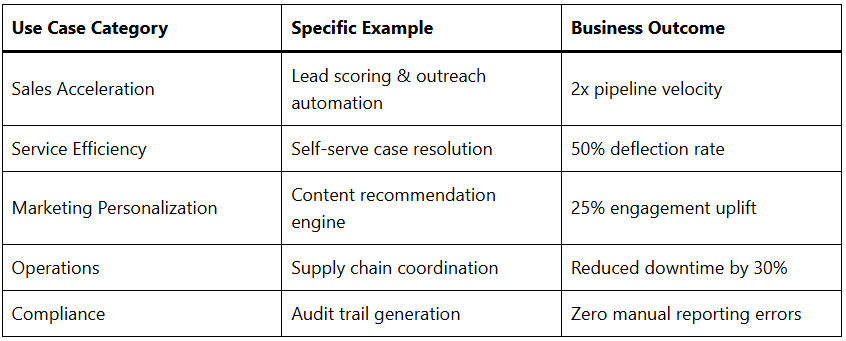
These cases demonstrate versatility, with Salesforce reporting enterprise clients achieving ROI within months.
Strategic Benefits for Enterprises
The primary advantage is hyper-productivity: agents handle volume, allowing humans to focus on empathy-driven interactions. Cost savings emerge from reduced headcount needs up to 30% in service teams while revenue grows via faster cycles.
Enhanced decision-making stems from real-time synthesis of petabyte-scale data, uncovering insights like churn predictors. Customer experiences are personalized at scale, boosting loyalty metrics like Net Promoter Scores.
Agentic workflows automate AEO (Answer Engine Optimization), generating SEO content variants and tracking performance against Salesforce campaigns. Security features like data masking ensure GDPR/CCPA compliance.
Implementation Roadmap and Best Practices
Start with discovery: map processes amenable to autonomy, prioritizing high-volume/low-complexity ones. Use Agent Builder for prototypes, testing in sandboxes with synthetic data.
Train agents with domain-specific prompts and monitor via Agent Console dashboards, iterating based on KPIs like task completion rate. Integrate with existing Flows for hybrid human-AI handoffs.
Scale via governance: establish AI ethics committees, conduct bias audits, and invest in change management upskilling via Trailhead modules. Partnerships with consultancies accelerate rollout.
Common pitfalls include over-automation without oversight; mitigate with confidence thresholds, routing uncertain cases to humans.
Overcoming Challenges
Hallucinations and edge cases challenge reliability; Salesforce’s grounded generation and verification loops address this, achieving 95%+ accuracy in pilots.
Scalability demands robust infra Agentforce leverages hyperscalers for elasticity. Ethical concerns like job displacement prompt reskilling initiatives, with Benioff advocating “agent economics.”
Data silos persist; Data Cloud unifies them. Cost management involves optimizing token usage and prioritizing high-ROI workflows.
2026 Outlook and Predictions
Experts predict agentic AI dominating CRM, with multi-agent “swarms” simulating entire departments. Trends include embodied agents interfacing with physical systems and federated learning for privacy-preserving collaboration.
Salesforce eyes “agent commerce,” where consumer agents negotiate deals autonomously. Regulatory frameworks will standardize observability, while open standards foster interoperability.
By 2027, 70% of enterprises will deploy agentic workflows, per Gartner analogs, transforming Salesforce users into AI-first organizations. For content creators, this means AI co-pilots for viral campaigns and predictive analytics on audience trends.
Agentic AI’s rise in Salesforce heralds an era of autonomous enterprise intelligence, blending cutting-edge tech with practical CRM power. As adoption surges, businesses harnessing these workflows will lead in efficiency, innovation, and customer-centricity essential for thriving in 2026’s dynamic markets.