

MrBeast and Salesforce launch $1M Super Bowl puzzle challenge
Introduction: Salesforce launch $1M Super Bowl puzzle challenge
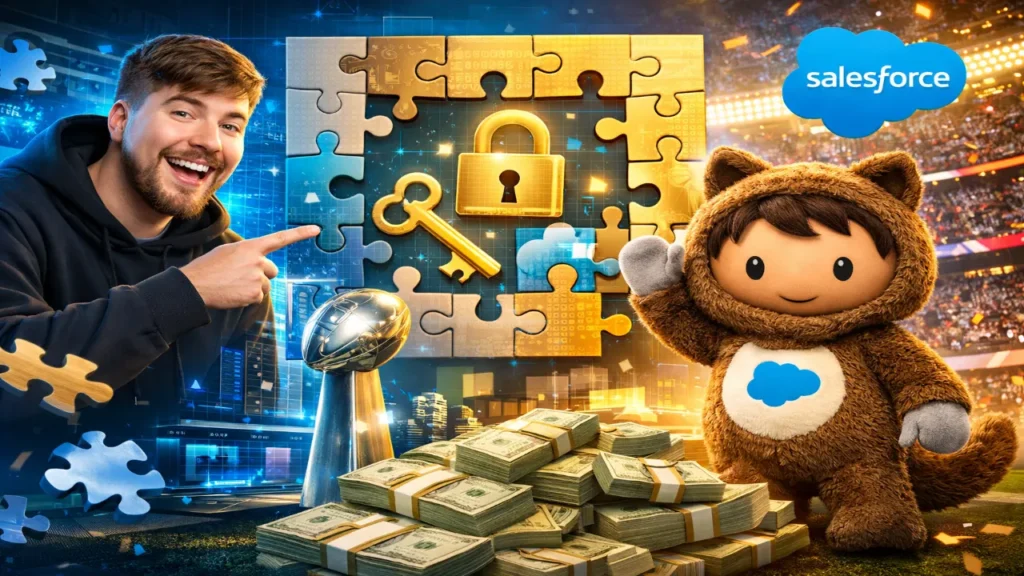
YouTube’s biggest creator, Jimmy “MrBeast” Donaldson, has partnered with tech giant Salesforce to transform this year’s Super Bowl into a $1 million challenge that combines fair play, puzzles, and real-time problem-solving. YouTube’s biggest creator, Jimmy “MrBeast” Donaldson, has teamed up with tech giant Salesforce to turn this year’s Super Bowl into a $1 million twist on fair play, puzzles, and real‑time problem‑solving. The challenge, centred on a hidden code embedded in an ad and a series of online videos, is designed so that any eligible person watching at home can, in theory, walk away a millionaire provided they crack every step of the puzzle before anyone else does. This fusion of influencer culture, brand marketing, and a live‑time riddle is transforming how audiences think about Super Bowl ads.
Table of Contents
What the $1M Super Bowl Puzzle Is
The core idea is elegantly simple, yet maddeningly tricky in execution. During their 30‑second Super Bowl spot, MrBeast walks through a vault‑like environment, flanked by layered security doors and red laser grids, while explaining that viewers must go online and complete a sequence of puzzles. Hidden inside the commercial and in a handful of complementary videos are clues that, when combined correctly, unlock a secret code. The first participant to send that code to MrBeast via Slack (Salesforce’s messaging platform) wins 1 million dollars.
There is no multiple‑step submission; there’s only one winning code and one winner. The structure is semi-nonlinear, meaning that clues sometimes loop back on one another instead of following a straight line, and some answers may depend on noticing tiny visual or audio Easter eggs that casual viewers might miss. Salesforce has said the goal is to reward curiosity, attention to detail, and persistence, not brute‑force guessing.
How the Challenge Actually Works
Here is how the puzzle experience unfolds for a typical viewer:
- After the Super Bowl ad airs, an on‑screen message directs viewers to a dedicated MrBeast–Salesforce microsite hosted under Salesforce’s domain.
- On that page, visitors are automatically entered into the puzzle challenge; no lengthy registration or payment is requested, though rules state participants must be at least 18 and legal residents of the United States, Canada, or Mexico.
- The site links to four core videos and additional mini‑clips uploaded by MrBeast during the preceding weeks. Each video is a capsule of visual, textual, and sometimes audio clues, all of which must be decoded and cross‑checked.
- Some symbols, timestamps, background numbers, or rapidly passing text on‑screen are believed to form parts of coordinates, passwords, or intermediate keys that you chain together.
- Ultimately, the collection of solved elements should yield one final code string that participants send to MrBeast inside Slack. The first correctly formatted DM with that exact code wins the jackpot.
Salesforce is also using its AI assistant, Slackbot, inside the same Slack workspace as a supportive tool. Participants can ask Slackbot targeted questions, which may nudge them toward the right section or confirm whether they are on the right track, but it cannot hand over the full solution outright, preserving the challenge’s competitive spirit.
Why It’s Going So Viral
Even a few hours after Super Bowl LX aired, news of the $1 million puzzle rapidly trended across social platforms. Analysts estimate that the contest microsite attracted tens of millions of visitors within the first day, with communities forming Reddit‑style “puzzle‑solving threads”, live‑streamed collaboration rooms, and shared Google Docs where users pool findings in real time.
The virality is attributed to a perfect combination of factors:
- MrBeast, a creator of some renown, is teaming up with a mainstream platform. He brings with him an audience used to big, splashy pop-culture happenings. Salesforce, on the other hand, is using its established brand reputation to position the campaign as genuine, not a hoax or a joke.
- Real‑money stakes with a low barrier to entry: Anyone watching the Super Bowl with a smartphone or laptop can theoretically play, creating a “what if I win?” The fear of missing out (FOMO) motivates individuals to continuously check the site and revisit the clues.
- Community‑driven collaboration: The fact that people help one another, especially through Slack channels and fan‑built wikis, re‑frames the competition as a shared culture, not just a winner‑takes‑all race.
- Enduring narrative tension: Early on, MrBeast mentioned in interviews that, as of late Sunday evening, no one had even come close to cracking the entire puzzle. That news sparked whispers that the clues might be more complex, perhaps even multi-faceted, than initially thought.
Observing these dynamics in real time offers content creators new case‑study fodder for how to design engagement‑driven campaigns that blend entertainment, brand awareness, and participation.
Inside the Creative and Marketing Strategy
Behind the spectacle lies a careful marketing strategy by Salesforce. Traditionally, Super Bowl ads rely on humour, celebrity cameos, or emotional storytelling to lodge in viewers’ memories. This year, Salesforce opted instead for participation marketing: audiences don’t just watch a story; they become active problem‑solvers inside a branded experience.
Handing creative control largely to MrBeast, a popular internet personality known for disrupting traditional advertising formats, signals that Salesforce wants to be considered aligned with internet-native culture rather than corporate-only branding. The vault and laser imagery in the ad visually parallel data security, which protects information; enterprise-grade workspaces, which are high-quality work environments designed for businesses; and AI-assisted workflows, which are processes enhanced by artificial intelligence, all wrapped inside a challenge. In the background of the spot, Slack’s interface is shown coordinating timelines and notes, subtly driving the message that organised digital collaboration can untangle even the most complex puzzles.
At the same time, the partnership leans into AI in a practical, user‑facing way. Instead of a talking‑head demo about machine‑learning models, AI appears as Slackbot: an embedded helper that answers questions, clarifies rules, and nudges people toward resources, turning abstract “AI hype” into a visible supporting player in the contest. This approach may influence how other brands conceive of AI‑powered campaigns in future ad‑and‑contest formats.
Hidden Clues, Hints, and How They’re Structured
While the precise sequence of clues remains locked inside the videos and the commercial, reporting and MrBeast’s own comments shed light on how the designers constructed the riddle.
Viewers are told to pay attention to anything that “looks wrong” or “off” in the footage: visual oddities, stretched aspect ratio strips, repeated background numbers, unusual colour swaps, or out‑of‑place text. In the initial spot, small numerals or letters appearing in corners, reflections, or textured surfaces may map to parts of codes or cyphers that must then be interpreted through other clips.
MrBeast has explicitly teased that numbers visible in photos he took at the Super Bowl itself could hold onwards hints. That edge‑case layer blurs the line between in‑game footage and behind‑the‑scenes content, encouraging fans to scour his social profiles and fan‑reposted images for additional pieces. This multi‑environment design makes the challenge nonlinear: solving it theoretically requires one to toggle between the broadcast video, the hosted website, and MrBeast’s side content, then reassemble insights in the correct order.
The contest page reportedly warns that no solution is brute‑force guessable, a clear signal that random keyboard‑smash attempts will fail and that intentional logic, careful documentation, and cross‑verification among team members will matter more.
Why This Campaign Matters Beyond the $1 Million
This Super Bowl puzzle offers more than just a chance to win. It also reshapes perceptions of what an ad can be. Instead of a passive interruption, the Salesforce–MrBeast commercial morphs into an interactive event that can be replayed, dissected, and re‑engaged as often as slow‑motion sports replays. That creates repeat touchpoints for the Salesforce brand far beyond the initial 30‑second window.
From a digital‑marketing standpoint, the experiment proves that embedding a real‑time, logic‑based experience inside a mass‑audience broadcast can spike not only views but also dwell time, collaboration, and conversation. Marketers in 2026 are closely watching how long the average user spends on the microsite, how frequently people send test messages to Slackbot, and how communities organise themselves to break the code. Those metrics will likely inform future campaigns blending influencer‑led challenges with AI‑assisted user support.
For MrBeast’s own brand, the project doubles as proof that his audience will follow him even into “hardcore puzzle‑solving” mode. After years of giving away cars, homes, and island vacations, launching a one‑winner‑only, code‑driven, high‑stakes mystery stretches his format into new territory. Fans who help crack the challenge benefit from social capital, being known as part of the solving community even if they don’t personally walk away with the prize.
How You Can Equip Yourself to Tackle Similar Puzzles
If you’re intrigued by the idea of entering future branded or community‑driven riddles like this one, here are practical habits to build:
- Slow‑motion and frame‑by‑frame analysis: Use native playback tools to pause and rewind videos repeatedly; even a split‑second text overlay or a single highlighted number can matter.
- Clean digital note‑taking: Keep a dedicated document where you log every observed element on‑screen text, timestamps, symbols, colours, and sounds with hypotheses next to them. That reduces the chance you miss a subtle link between clips.
- Collaborative problem-solving: Join or create small groups or channels where team members leverage their strengths; one person may identify numbers, another may decipher cyphers, and a third may organise timelines.
- Ask structured questions from assistants: when tools such as AI‑powered chatbots or bots are allowed, phrase questions narrowly, not “tell me the answer”, but “does the number 37 appear in any of the four main videos?” or “suggest possible cypher types that match this pattern.”
- Respect the rules and timelines: Campaigns like these usually have clear age, geography, and time‑limit constraints. Staying within those preserves eligibility and prevents wasted effort on technicalities.
The Cultural Impact of the $1M Puzzle
This year’s MrBeast–Salesforce partnership hints at what the future of big‑budget advertising could resemble: less polished monologue, more shared participation. As long‑form campaigns grow into live‑event experiences on‑screen, brands may increasingly wrap promotions around puzzles, scavenger hunts, or collaborative missions backed by real‑world rewards.
For fans, that means more opportunities to earn, create, and contribute rather than simply watch. For content creators, it offers a fresh template for how to scale engagement beyond likes and comments into structured, time‑bound challenges that encourage deeper attention and longer interaction.
As of now, that elusive million-dollar code still waits patiently inside the fragments of four subtly misdirecting videos, a vault-walk ad, and a buzzing Slack workspace, which is a messaging platform used for team communication. Someone, somewhere, is one decoded clue away from becoming a sudden millionaire while the rest of us watch, learn, and get ready for the next wave of branded, puzzle‑driven storytelling.