

Marc Benioff Says AI Will Boost Productivity, Not Replace Jobs
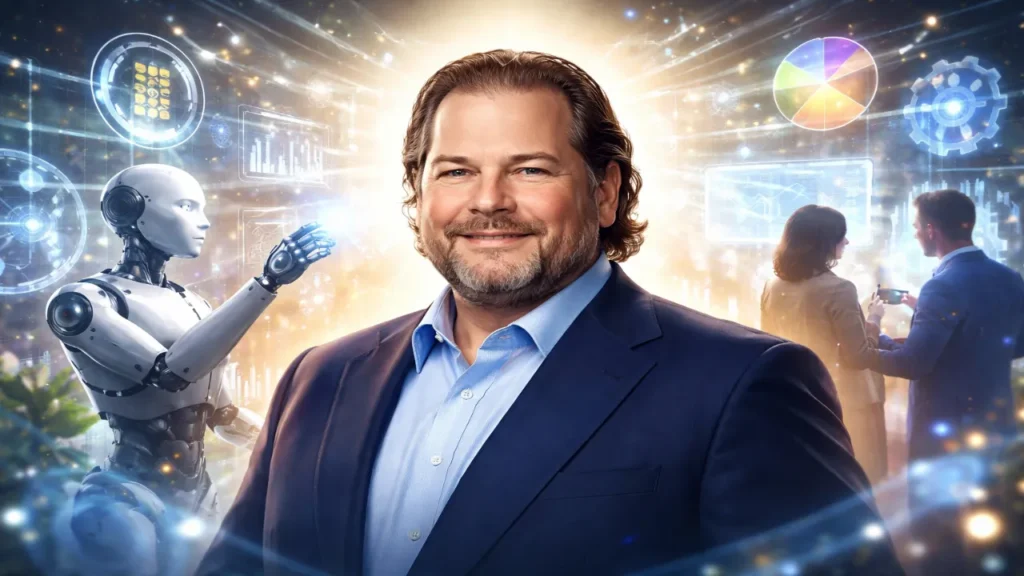
Artificial intelligence is transforming the way businesses operate across industries. From automating repetitive tasks to delivering intelligent insights, AI is becoming an essential part of modern digital transformation. However, one of the biggest concerns surrounding AI adoption is whether it will replace human jobs. Addressing this debate, Marc Benioff, the CEO of Salesforce, has consistently emphasised that AI is designed to enhance human productivity rather than replace workers.
Benioff believes that AI should be viewed as a powerful assistant that helps employees perform their roles more efficiently, allowing them to focus on higher-value tasks. As companies adopt AI technologies at scale, the focus is shifting from job displacement to job transformation and productivity growth.
Table of Contents
The Growing Role of AI in the Modern Workplace
Artificial intelligence has rapidly evolved from a futuristic concept into a core component of business operations. Companies are using AI to automate processes, analyse massive datasets, and provide personalized customer experiences.
According to Marc Benioff, AI is becoming deeply embedded across platforms like Salesforce Einstein AI and Salesforce Agentforce, enabling organizations to streamline operations and deliver better results.
Instead of replacing employees, these AI systems help workers by:
- Automating repetitive administrative tasks
- Providing real-time insights for better decision-making
- Improving customer service through intelligent automation
- Enhancing collaboration across teams
This shift allows employees to focus more on strategy, creativity, and problem-solving, which are areas where human intelligence remains irreplaceable.
AI as a Productivity Multiplier
Marc Benioff often describes AI as a “productivity multiplier”. In this context, AI tools act as digital assistants that help employees complete tasks faster and with greater accuracy.
For example, AI can automatically summarise customer conversations, generate reports, or suggest next steps for sales teams. This reduces the time spent on manual work and enables professionals to dedicate more attention to customer relationships and innovation.
Within the Salesforce ecosystem, tools such as Einstein Copilot are designed to help employees quickly access information, generate content, and automate workflows. These capabilities significantly improve efficiency across departments like sales, marketing, service, and operations.
Benioff believes that when AI is implemented responsibly, it can unlock new levels of productivity that were previously impossible.
The Evolution of Jobs in the AI Era
Throughout history, technological advancements have always changed the nature of work. The introduction of computers, the internet, and cloud computing all transformed industries and created new job roles.
Marc Benioff argues that AI will follow a similar path. While certain routine tasks may become automated, new roles will emerge that focus on:
- AI management and oversight
- Data analysis and insights
- Ethical AI governance
- AI-driven customer experience design
Organizations adopting AI technologies will need employees who can work alongside intelligent systems, interpret insights, and make strategic decisions.
This means the workforce will not disappear but instead evolve into more advanced and specialized roles.
Human Skills Will Become More Valuable
While AI excels at processing large volumes of data and automating tasks, it still lacks key human capabilities such as empathy, creativity, ethical judgement, and emotional intelligence.
Marc Benioff stresses that these uniquely human qualities will become even more important in the AI-powered workplace. Employees will need to focus on skills like the following:
- Critical thinking
- Strategic decision-making
- Creative problem-solving
- Relationship building
- Leadership and collaboration
AI can assist with information and automation, but humans remain essential for interpreting results, building trust, and delivering meaningful experiences.
For example, customer service agents supported by AI tools can quickly access customer data and recommendations, but the human agent still provides empathy and personalized support.
AI and Responsible Innovation
Another key aspect of Benioff’s perspective is the importance of responsible AI development. As companies deploy AI across their operations, they must ensure that systems are transparent, ethical, and trustworthy.
Salesforce has emphasised responsible AI practices to ensure that technology benefits both businesses and society. These principles include:
- Transparency in AI decision-making
- Protection of customer data and privacy
- Fair and unbiased algorithms
- Human oversight of AI systems
By focusing on responsible innovation, companies can build AI solutions that empower employees while maintaining trust with customers.
AI in Customer Relationship Management
Customer relationship management platforms are among the biggest beneficiaries of AI innovation. By combining AI with CRM systems, organizations can better understand customer behaviour, predict needs, and deliver personalized experiences.
Through AI-powered CRM tools, businesses can:
- Predict customer purchasing behaviour.
- Identify potential sales opportunities
- Automatically route service requests
- Generate marketing content and campaigns
These capabilities enable companies to operate more efficiently while improving the overall customer experience.
Marc Benioff believes that AI-powered CRM platforms will become the digital backbone of modern organizations, helping teams work smarter and make data-driven decisions.
The Rise of AI Agents in Business
Another emerging trend highlighted by Benioff is the rise of AI agents, autonomous digital assistants capable of completing tasks and interacting with systems on behalf of users.
Platforms like Agentforce are designed to create AI agents that can perform functions such as customer support, workflow automation, and data analysis.
However, Benioff emphasises that these AI agents should be seen as partners for employees rather than replacements. They handle repetitive tasks while humans focus on strategic work.
For example:
- AI agents can process customer inquiries instantly
- Human representatives handle complex or emotional issues
- AI provides recommendations while humans make final decisions
This collaborative model between humans and AI is expected to become the standard approach for businesses in the coming years.
AI Adoption Across Industries
The adoption of AI is expanding rapidly across multiple industries, including healthcare, finance, retail, manufacturing, and technology.
Businesses are using AI to improve operations in areas such as the following:
- Predictive analytics for forecasting
- Automated customer support systems
- Intelligent marketing personalization
- Fraud detection and risk management
- Supply chain optimization
As these technologies continue to evolve, organizations that embrace AI early are likely to gain a significant competitive advantage.
Marc Benioff believes that companies must embrace AI innovation while preparing their workforce with the right skills and training.
Preparing the Workforce for an AI Future
To fully benefit from AI, organizations must invest in employee education and skill development. Workers need to understand how AI tools operate and how to integrate them into daily workflows.
Training programs focused on digital skills, data literacy, and AI collaboration will become increasingly important. Companies that prioritise workforce development will be better positioned to maximise the value of AI technologies.
Marc Benioff encourages businesses to adopt a mindset where AI is seen as a tool for empowerment rather than a threat. When employees are equipped with the right skills, AI can significantly improve job satisfaction and productivity.
The Future of AI and Work
The conversation around AI and employment will continue as technology evolves. However, leaders like Marc Benioff believe that the future of work will be defined by human-AI collaboration rather than competition.
AI systems will handle repetitive and data-heavy tasks, allowing humans to focus on creativity, innovation, and strategic thinking. This partnership between technology and people has the potential to unlock new opportunities across industries.
As AI continues to mature, businesses will need to balance technological advancement with ethical responsibility and workforce development.
Conclusion: Marc Benioff Says AI
Artificial intelligence is reshaping the global workforce, but it does not necessarily mean the end of human jobs. According to Marc Benioff, AI should be viewed as a tool that enhances productivity and empowers employees rather than replacing them.
By integrating AI into everyday workflows, organizations can automate routine tasks, generate valuable insights, and improve customer experiences. At the same time, human skills such as creativity, empathy, and leadership will remain essential.
The future workplace will likely be defined by collaboration between humans and intelligent machines, where AI acts as a powerful assistant that helps people achieve more.
For businesses embracing digital transformation, the key is not to fear AI but to use it responsibly to unlock innovation, productivity, and growth.