

Marc Benioff Says AI Is Still Not Ready to Replace Engineers
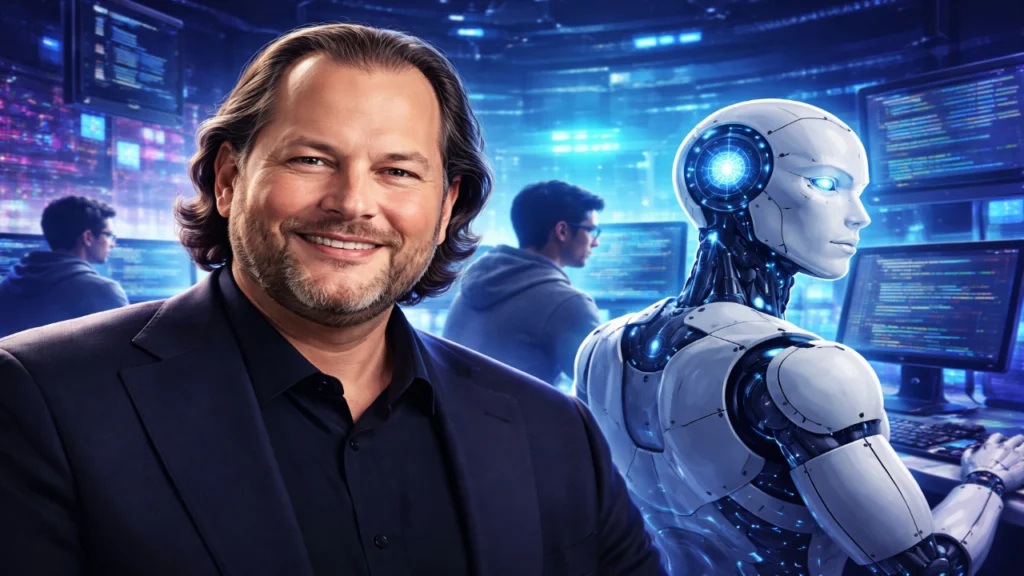
Introduction: Marc Benioff Says AI Is Still Not Ready to Replace Engineers
There is something both refreshing and reassuring about a tech CEO standing in front of the world and admitting that artificial intelligence, for all its breathtaking progress, is simply not ready to walk into an engineering department and take over. Marc Benioff, the founder and CEO of Salesforce, has never been shy about sharing bold opinions. But his recent remarks on AI and software engineering hit differently. Not because they shocked, but because they felt honest in a space that is often crowded with hype.
The conversation around AI replacing software engineers has been building for years. With tools like GitHub, Copilot, ChatGPT, and Salesforce’s own AgentForce entering the development workflow, it was only natural for people to start asking the question: are engineers still necessary? Benioff’s answer, in essence, is yes — and for good reason.
Table of Contents
The Hype Machine Is Loud, but Nuance Matters
Every few months, a new headline announces the death of some profession at the hands of artificial intelligence. Writers, lawyers, doctors, designers, and, of course, software engineers have all put themselves in a vulnerable position. While artificial intelligence has indeed changed some repetitive tasks in these fields, there’s still a significant difference between what AI can actually do and what we think it can do. Benioff understands this imbalance well.
Salesforce, a significant force in enterprise software, relies on a large and talented engineering team. These engineers are the architects, caretakers, and innovators behind the intricate systems that keep the company running. When he says AI is not yet ready to replace those engineers, he is not speaking from a place of ignorance or technophobia. He is speaking from experience watching AI tools operate inside one of the most sophisticated software ecosystems in existence.
The distinction Benioff draws is an important one. AI can assist engineers. It can accelerate them. It can reduce friction in repetitive coding tasks, help debug certain classes of errors, and generate boilerplate code faster than any human ever could. But assisting is not the same as replacing. A hammer helps a carpenter build a house, but no one is suggesting we eliminate carpenters and just hand houses over to hammers.
What AI Can Do and What It Can Not
To understand Benioff’s position, it helps to be clear-eyed about the current state of AI in software development. AI models today are remarkably proficient at pattern recognition. They have been trained on enormous volumes of code, documentation, and developer forums, which means they can make intelligent guesses about what a developer is trying to write. Often, those guesses are accurate and time-saving.
However, building enterprise-grade software is not fundamentally about pattern recognition. It is about understanding business logic, navigating the organisational context, making architectural decisions with long-term consequences, debugging systems that span dozens of interdependent services, and constantly communicating with product managers, designers, stakeholders, and fellow engineers. It is equal parts technical and human.
AI, as it exists today, lacks business context. It doesn’t understand why a legacy system was built the way it was. It does not understand the political dynamics of a product roadmap. It cannot sit in a room with a frustrated customer and translate their complaint into a technical requirement. These are not small gaps. They are the bulk of what senior engineers spend their time on.
There is also the matter of accountability. When an AI writes a piece of code that breaks production at 2 AM on a Friday, someone still needs to know enough to correct it. That someone is an engineer. While AI can generate a preliminary version, it’s the engineers who ultimately shape the finished product.
Benioff’s Bigger Point: Augmentation Over Replacement
Reading between the lines of Benioff’s comments, the more important message is not just that AI is unready – it is that the framing of “replacement” is fundamentally wrong. The more productive question is not “Can AI replace engineers?” but rather “how does AI change what it means to be an engineer?”
This reframing matters because it shifts the conversation from fear to strategy.
Engineers who learn to work alongside AI tools effectively will be significantly more productive than those who do not. A developer who can prompt an AI to generate scaffolding code, critically review the output, intelligently refactor it, and ship it faster is not replaced by AI. That developer amplifies it.
This is the vision Benioff seems to be pointing toward.
Salesforce has invested heavily in agentic AI — systems that can autonomously complete tasks within defined boundaries. But even in Salesforce’s own deployment of these tools internally, the company has not dramatically reduced its engineering headcount. As a result, the nature of engineering work has changed, encouraging developers to focus on more impactful tasks and reducing the time spent on less important, repetitive activities.
The Workforce Fear Is Real, Even If Premature
None of these concerns about AI and engineering jobs are baseless. Benioff isn’t ignoring the concerns; he’s putting them in context. There’s a significant distinction between claiming that “AI won’t impact engineering jobs” and acknowledging that “AI isn’t prepared to supplant engineers currently”. The second statement leaves open the possibility of future disruption, and any honest assessment of technology must do that.
Junior engineers and entry-level developers may face a particularly interesting period ahead. If artificial intelligence tools simplify the automation of tasks usually performed by less experienced developers, companies might hire fewer entry-level employees. This is a valid concern that the industry needs to address carefully. Solutions could include training programmes, mentorship, and a reevaluation of how developers progress in their careers.
But the answer to that concern is not to pretend the technology does not exist. It is to prepare engineers, especially early-career ones, to understand and work with these tools from the beginning, treating AI literacy as a core professional skill rather than an optional add-on.
What the Industry Should Take From This
When someone of Benioff’s stature pumps the brakes on AI replacement narratives, it carries weight. This is not a Luddite speaking. This is the CEO of a company that sells AI products, has deployed AI internally at scale, and has a direct financial stake in people believing in the transformative power of the technology. His willingness to say “not yet, not fully” is a form of intellectual honesty that is rare in Silicon Valley.
For engineers reading this document, the message should be energising rather than deflating. Your skills are not obsolete. Your judgement, your problem-solving ability, your understanding of complex systems, and your ability to work with human beings – none of these things are going away. What is changing is the toolkit you work with, and that has always been true.
Every generation of engineers has adapted to new tools, from the introduction of object-orientated programming to the rise of cloud infrastructure to the age of open-source software. AI is the next chapter in that story, not the last one.
For companies, the message is equally clear. Do not use AI hype as an excuse to underinvest in your engineering teams. The organizations that will thrive in the next decade are not the ones that replaced engineers with AI, but the ones that built strong teams of engineers who know how to use AI well.
The Bottom Line
Marc Benioff’s comments are a grounding force in a conversation that has too often drifted into science fiction. AI is powerful, and it is getting more powerful every year. But power and readiness are not the same thing. A jet engine is more powerful than a bicycle, but you still need a trained pilot to fly the plane.
Software engineering is, at its core, a human discipline. It requires creativity, judgement, empathy, and accountability in ways that current AI systems genuinely cannot replicate. Benioff sees this clearly, and he is right to say it out loud.
The future belongs to engineers who embrace AI as a partner, not as a threat and not as a replacement, but as a tool that makes their work faster, sharper, and more impactful. That future is already here. The engineers who thrive in it will be the ones who stopped asking whether AI would replace them and started asking what they could build with it instead.