

How Salesforce Stock Trends Affect CRM Professionals Now

Introduction: Salesforce Stock Trends
Salesforce’s stock has shown volatility in early 2026, with declines linked to slower growth and layoffs, yet AI innovations like Agentforce offer rebound potential. CRM professionals face indirect impacts through job markets, compensation, and industry confidence. This blog explores these dynamics in detail.
Table of Contents
Recent Stock Performance Overview
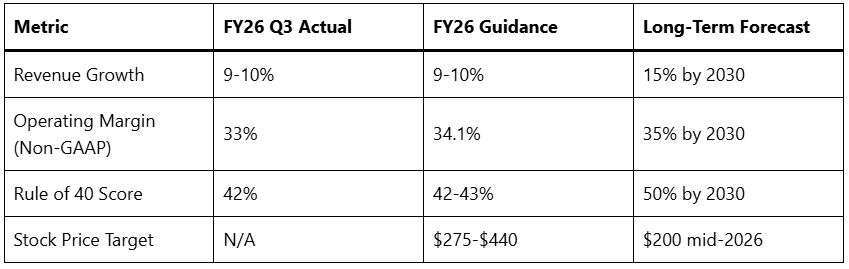
Salesforce (CRM) stock traded around $196-$267 in recent months, down nearly 20% over the past year amid decelerating revenue growth to 8-10%. Q3 FY26 results showed record revenue of $10.3 billion, up 9% year-over-year, driven by Agentforce and Data Cloud generating $1.4 billion in recurring revenue, up 114%. However, shares plunged on concerns over single-digit growth, layoffs of 1,000 employees, and leadership changes, with forecasts predicting a drop to $173 by the end of February.
Full-year FY26 guidance projects $41.45-41.55 billion in revenue, 9-10% growth, and 34.1% non-GAAP operating margin. Analysts maintain a “Moderate Buy” rating with targets up to $326, citing AI momentum despite volatility. Over 52 weeks, CRM fell 42% at points, underperforming peers like Microsoft (up 14%).
Key Drivers of Stock Volatility
AI integration boosts optimism, with Agentforce deals up 330% year-over-year, half from existing clients. Yet, economic caution leads to smaller IT budgets, slowing large deals, and contributing to 17.9% annual decline. Layoffs in core teams, including AI, amid $2.59 billion trading volume signal restructuring, eroding confidence.
Broader IT spending rises 9.8% to $6.08 trillion in 2026, with software up 15.2%, supporting Salesforce’s 23% CRM market share. Forecasts vary: mid-2026 at $200, rising to $250 by 2029, but short-term stress tests loom with Q4 earnings.
Direct Impacts on Salesforce Employees
Many CRM pros at Salesforce receive RSUs vesting over 4 years and stock options at discounts, tying wealth to CRM performance. Declines amplify financial stress, especially post-layoffs targeting Agentforce teams. Executive turnover adds uncertainty, with opaque restructuring under new leadership.
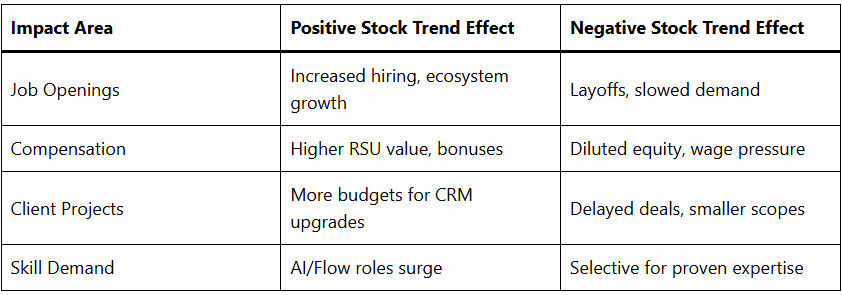
Hiring slowed 46% in prior years but stabilized for 2026, focusing on AI skills. Professionals with equity face diluted value during dips, prompting some to diversify or seek stable roles elsewhere.
Broader Effects on CRM Professionals
Stock trends signal industry health, influencing client budgets and partner hiring. Downturns correlate with selective demand: resilient but focused on AI-savvy talent. Job growth persists in high-paying roles like architects (six figures), fueled by Salesforce’s ecosystem projecting 4.2 million jobs.
Volatility raises caution; weaker stock prompts cost controls, delaying implementations and reducing consultant needs. Conversely, rebounds boost confidence, expanding opportunities in automation and Data Cloud. Salaries remain strong for certified pros amid 23% market dominance.
Strategic Advice for CRM Pros
Upskill in Agentforce, Data 360, and AI to align with growth drivers. Diversify income beyond stock-heavy packages; negotiate base pay in volatile times. Monitor Q4 FY26 earnings around February 26 for signals.
Network on LinkedIn for partner roles less tied to public stock swings. Track metrics like cRPO (up 15%) for early trend insights. Long-term, Salesforce’s AI pivot positions pros for recovery, with 20-50% stock upside possible.
Future Outlook and Opportunities
Projections show CRM hitting $200 mid-2026, with AI fueling 15% growth by 2030. Professionals adapting to autonomous agents thrive amid ecosystem expansion. While short-term dips challenge careers, resilience in IT spending ensures demand.
Stay agile: volatility favors versatile experts over generalists. Salesforce’s platform evolution creates niches in enterprise AI, benefiting proactive CRM talent.