

How Salesforce Is Leading the Agentic AI Revolution in CRM
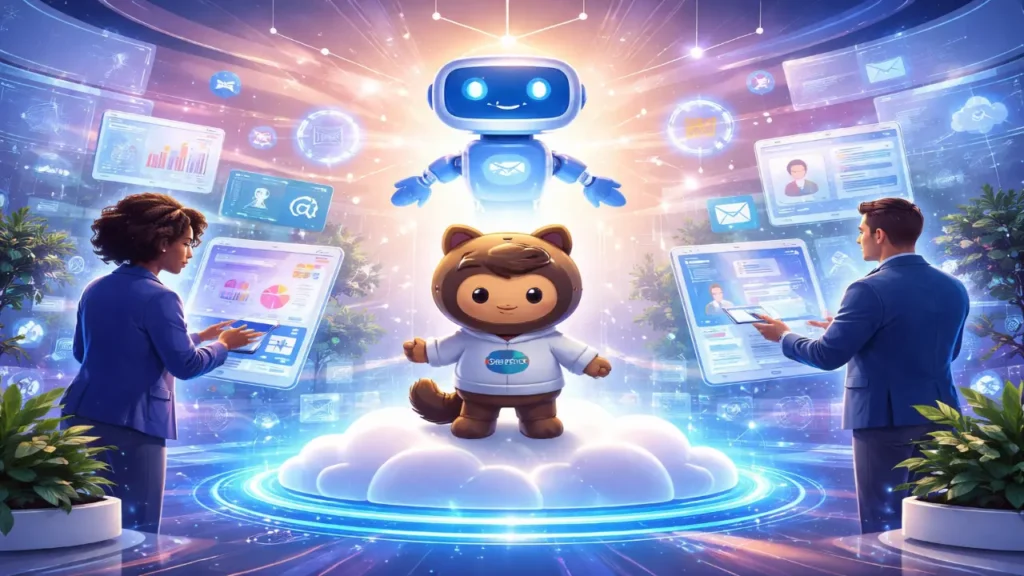
In today’s hyper-competitive business landscape, customer expectations have evolved faster than ever. People no longer want generic service; they expect intelligent, personalized, proactive, and seamless experiences across every touchpoint. Traditional Customer Relationship Management (CRM) systems once focused on storing contact information, tracking sales opportunities, and managing service cases are now being reinvented by artificial intelligence. At the forefront of this shift is Salesforce, championing what many experts call the Agentic AI Revolution in CRM.
But what does “agentic” mean in AI? And how exactly is Salesforce leveraging this to transform CRM? This blog dives into the heart of Salesforce’s strategy exploring its technology, use cases, business value, and why it’s ahead in ushering in the next era of intelligent customer engagement.
Table of Contents
1. What Is Agentic AI? A New Paradigm in CRM
Agentic AI refers to autonomous, context-aware artificial intelligence systems capable of taking actions, making decisions, and solving problems on behalf of users beyond simply making predictions or recommendations.
Where traditional AI functions as a predictive assistant (e.g., suggesting what a rep might say next), agentic AI acts as a proactive collaborator. It doesn’t wait for instructions it anticipates needs, orchestrates workflows, and drives outcomes.
In CRM, agentic AI means customers receive the right response before they even ask for it. Sales teams get suggested next best actions customized to account history. Service agents are assisted with resolved solutions based on context. Marketing teams automatically orchestrate journey actions that resonate with each individual’s behavior.
2. Salesforce’s Vision: Intelligent CRM for Every Business
Salesforce has long positioned itself as a pioneer in cloud CRM. With more than two decades of innovation, the company’s mission has always been to help organizations understand and engage customers in meaningful ways.
But as the volume of data exploded from emails, chats, digital behavior, mobile interactions, social engagement, IoT signals, and more manual engagement became impossible to scale. This created the perfect environment for AI to thrive.
Salesforce’s vision has evolved to:
📌 Turn data into intelligence
📌 Transform intelligence into action
📌 Empower teams with decision-making autonomy
The logical culmination of this is agentic AI — where orgs no longer just react to customer data, they leverage AI-powered agents to create remarkable experiences at scale.
3. Salesforce’s AI Foundation: Built on Trust, Scalability, and Ethics
Before diving into specific products, it’s critical to understand the foundation Salesforce uses for its AI strategy:
a. Trust-First AI
Salesforce places trust and ethical AI at the core of its innovation. This includes principles like:
- Transparency and explainability of AI outputs
- Bias mitigation
- Data privacy and security
- Human-in-the-loop controls
This is essential because CRM often involves sensitive customer data and businesses must trust AI to make decisions without sacrificing compliance or ethics.
b. Scalable Data Architecture
Salesforce’s multi-tenant cloud architecture allows massive volumes of structured and unstructured data to flow into unified data models. This convergence of data is vital for agentic AI the smarter the AI, the richer the context.
Unified Customer Profiles, 360° views of behavior, and real-time interaction streams are the lifeblood of intelligent CRM.
c. AI Model Flexibility
Salesforce supports both pre-trained and customizable AI models meaning businesses can benefit from general intelligence while also tailoring AI to specific industry or organizational needs.
This flexibility fuels adoption across diverse sectors: finance, healthcare, retail, manufacturing, telecommunications, and more.
4. Key Salesforce Products Powering the Agentic AI Revolution
Salesforce’s strategy is not just theoretical — it’s executed through a suite of AI-embedded solutions that are redefining CRM:
a. Einstein AI: The Embedded Intelligence Layer
Salesforce Einstein is the company’s AI layer built into the CRM platform. Einstein brings intelligence directly into workflows across Sales Cloud, Service Cloud, Marketing Cloud, and more. Its capabilities include:
- Predictive Lead Scoring
- Opportunity Insights
- Automated Case Classification
- Sentiment Analysis
- Personalized Recommendation Engines
Einstein doesn’t require separate integration — it’s native to Salesforce’s data model, enabling contextual relevance and real-time capabilities.
But Einstein is more than a set of models — it’s a core enabler of agentic outcomes. For example:
- Suggesting next best actions
- Triggering automated service resolutions
- Routing cases intelligently based on urgency and agent skills
This is agentic behavior making decisions that propel business workflows forward without constant human direction.
b. Tableau AI and Analytics
Data without insight is noise. Salesforce’s acquisition of Tableau empowers organizations to visualize patterns, uncover deep insights, and forecast trends.
With AI augmentation, Tableau allows:
- Natural language queries to generate charts automatically
- Automated clustering and anomaly detection
- Predictive forecasting embedded in dashboards
This means business teams can ask questions like “Which accounts are likely to churn next quarter?” and get actionable answers reducing decision latency from weeks to minutes.
c. Slack AI and CRM Collaboration
Salesforce’s acquisition of Slack was more than a chat tool — it created a collaborative layer where AI-assisted CRM activities happen in real time.
For instance:
- Slack AI can summarize case threads automatically.
- It can recommend resources or past solutions across channels.
- Sales teams can automatically update CRM records from Slack conversations.
This blurs the line between collaboration and operational execution a hallmark of agentic systems.
d. Flow Automation and AI Orchestration
Salesforce Flow empowers businesses to automate complex processes and when combined with AI, those workflows become intelligent.
Example:
A customer opens a support ticket indicating frustration. AI detects sentiment and urgency, then:
- Triggers high-priority escalation
- Notifies specific agents
- Suggests a sequence of responses
- Enqueues follow-up tasks
This kind of automated orchestration represents a major jump from static workflow rules to dynamic AI-powered process automation.
5. Real-World Use Cases of Salesforce’s Agentic AI
Customer Service Revolution
Service teams equipped with AI can:
- Auto-route cases based on predicted complexity
- Fetch relevant knowledge base articles dynamically
- Suggest resolution scripts based on sentiment
- Automatically follow up with customers
This dramatically increases first-contact resolution rates and customer satisfaction scores.
Sales Acceleration
Sales teams benefit from AI-driven insights like:
- Predicting which deals are most likely to close
- Recommending optimal next engagement steps
- Detecting buyer intent signals from interactions
- Automating routine data entry, freeing reps to sell
Result? Sales cycles shrink and conversion rates improve measurably.
Marketing Personalization at Scale
With agentic AI in Marketing Cloud:
- Customer journeys adapt in real time based on behavior
- Emails are optimized automatically for best send times and content
- Engagement scoring drives hyper-personalized segments
Marketing becomes not just targeted, but anticipatory.
6. Business Value: What Salesforce’s Agentic AI Delivers
When implemented strategically, Salesforce’s agentic AI model delivers tangible value:
💡 Higher Revenue Growth
By predicting customer needs and automating cross-sell/upsell suggestions, organizations see improved average deal sizes and conversion rates.
💡 Faster Case Resolution
AI assistance accelerates service outcomes while reducing operational costs.
💡 Improved Employee Productivity
Reps spend less time on manual tasks and more on high-value relationships.
💡 Stronger Customer Loyalty
Customers get smarter responses, personalized journeys, and fast resolutions driving retention.
💡 Data-Driven Organizational Agility
Real-time intelligence enables teams to pivot strategies quickly based on actual insights.
7. Challenges and the Path Forward
Even with powerful capabilities, there are challenges:
🔹 Data Quality and Governance
AI is only as good as the data it consumes. Organizations must invest in data hygiene and governance.
🔹 Change Management
Adopting agentic AI requires process redesign, training, and cultural readiness.
🔹 Ethics and Trust
Businesses must ensure transparency, fairness, and compliance to maintain trust in automated decision-making.
Salesforce recognizes these challenges and embeds guardrails but the journey toward fully agentic, autonomous CRM will be iterative.
8. Conclusion: Salesforce’s Leadership in an AI-Driven Future
The CRM industry is undergoing a paradigm shift. Intelligence is no longer a luxury — it’s expected. Salesforce isn’t just responding to this shift — it is shaping it.
By combining unified customer data, ethical AI practices, embedded intelligence, workflow automation, and real-time collaboration tools, Salesforce is transforming CRM into an agentic system capable of anticipating needs, acting autonomously, and delivering outcomes that matter.