

How Autonomous CRM Systems Will Reshape Business Models
Autonomous CRM systems use AI agents to independently handle customer interactions, data management, and workflows, freeing teams from manual tasks and driving proactive business operations. These systems mark a shift from traditional CRMs, which require constant human input, to intelligent platforms that act autonomously based on real-time data and context.
Table of Contents
What Are Autonomous CRM Systems?
Autonomous CRMs go beyond AI-assisted tools by operating without supervision, making decisions, and executing actions like updating records or scheduling follow-ups. Platforms like Salesforce Agentforce and Einstein embed AI agents that process natural language queries, integrate data from sources such as Data Cloud, and trigger workflows across sales, service, and marketing.
Key features include ambient intelligence for detecting buying signals, predictive deal management to revive stalled opportunities, and conversational assistance for generating personalized content from transcripts. Unlike legacy systems plagued by manual data entry, consuming up to 72% of sales time, these tools create living records of interactions in real-time.
Shift from Traditional to Autonomous CRMs
Traditional CRMs function as databases demanding manual logging, leading to low adoption, stale data, and reactive workflows. Autonomous systems flip this by proactively acting: auto-logging calls, prioritizing leads via adaptive scoring, and orchestrating end-to-end customer journeys.
Enablers include AI/ML for pattern recognition, cloud APIs for seamless integrations, and omnichannel data streams. By 2025, 70% of CRMs will have integrated AI, with autonomous actions cutting sales cycles and acquisition costs. This evolution turns CRMs into “business engines” rather than repositories.
Core Technologies Powering Autonomy
AI agents in platforms like Clarify or PiperMind use intent recognition to create evolving deal summaries and predictive analytics to forecast churn or upsell opportunities. Salesforce Einstein, for instance, grounds responses in CRM data and third-party sources for personalized, accurate actions.
Workflow orchestration enables execution: auto-sending emails, escalating tickets, or assigning leads based on probability. Agentic AI handles structured tasks like record updates and routing without oversight, scaling efficiency across departments.
Business Model Transformations
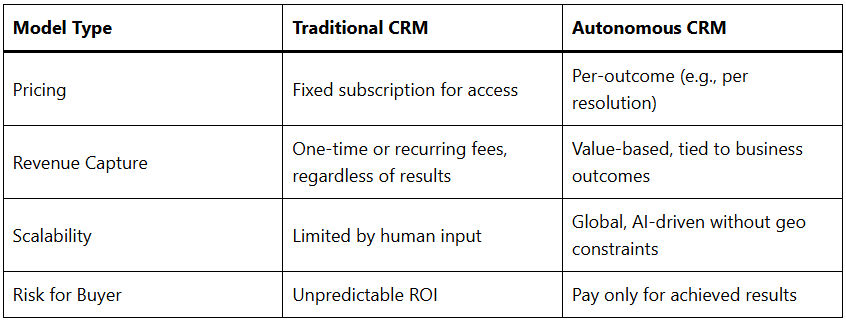
Autonomous CRMs drive a pricing shift from fixed subscriptions to outcome-based models, where vendors charge per result, like $2 per Agentforce conversation or $0.99 per Intercom resolution. This aligns incentives: customers pay for value delivered, such as faster deal closures or deflected support cases.
Companies transition to value-based revenue, enabling global scaling without proportional costs and continuous subscriptions over one-time fees. For vendors, it means predictable outcomes from AI execution; for users, ROI tied directly to metrics like win rates or retention.
Impacts on Operations and Revenue
Sales teams gain 50,000+ hours by automating summaries and follow-ups, shortening cycles by 30% and boosting conversions. Marketing sees 20-25% higher rates via hyper-personalized journeys from unified profiles.
Service reduces response times by 50% and costs by 20-30% through autonomous routing. Overall, firms report 41% win rate jumps and 40-60% operational savings.
Real-World Examples and Case Studies
Salesforce’s internal use of Agentforce unified 266 million profiles, enhancing targeting. A retail shop cut manual work 40%, lifting repeat purchases 30%. E-commerce firm RetailOps Pro achieved 3-5% error drops and massive weekly savings via AI order processing.
SaaS startups saw 25% conversion gains from automated pipelines. Companies like OpenTable and Wiley improved efficiency with Agentforce integrations.
Challenges in Adopting Autonomous CRMs
Key hurdles include data quality for AI accuracy, change management for team resistance, and governance for autonomous actions. Risks involve fragmentation without oversight or ignoring compliance.
Phased migration, starting with data entry elimination, then predictive workflows, full autonomy mitigates this, tracking metrics like cycle length.
Future Outlook
By 2027, 70-80% of firms will deploy autonomous agents, doubling from 2025. Expect collaborative, context-aware agents deeply embedded in CRMs, evolving to unified GTM platforms handling prospecting to renewals.
Businesses prioritizing this will outpace manual competitors, focusing humans on strategy amid AI-orchestrated operations. Early adopters in high-volume sectors like SaaS and sales will lead.