

How AI Improves Salesforce Development Speed by 45%
The enterprise software domain is currently navigating a structural paradigm shift comparable to the transition from manual craftsmanship to industrial assembly. At the center of this transformation is the Salesforce ecosystem, where the convergence of generative artificial intelligence and autonomous agentic systems has fundamentally redefined the parameters of productivity and technical delivery.
While the industry frequently cites a 45% improvement in development speed, this figure represents a complex synthesis of workday savings, task-specific acceleration, and a rapid shift in tool adoption across the global developer community. This report provides an exhaustive analysis of how these efficiencies are achieved, the technological foundations supporting them, and the broader economic implications of the digital labor movement within the Salesforce platform.
Table of Contents
Decoding the 45% Metric: A Multi-Dimensional Analysis of Productivity
The 45% efficiency gain often highlighted in contemporary discourse is not a singular observation but a multifaceted metric derived from diverse research streams. According to a comprehensive report by IDC, sponsored by Salesforce, the integration of AI tools allows IT workers to save approximately 45% of their typical workday, which translates into roughly 3.6 hours of reclaimed time in an eight-hour shift. This reclaimed time is primarily the result of automating routine, repetitive tasks and accelerating complex workflow processes that previously required intensive manual intervention. In comparison, line-of-business workers experience a slightly lower but still significant saving of 39%, or 3.1 hours daily, underscoring the particular effectiveness of AI in technical and logic-heavy environments.
Beyond workday duration, the 45% figure correlates with the dramatic surge in the adoption of sophisticated coding assistants. Between 2023 and 2024, the utilization of GitHub Copilot among Salesforce developers rose from 17% to 45%, while the adoption of ChatGPT for development tasks soared from 56% to 86%. This rapid uptake indicates that nearly half of the Salesforce development workforce has transitioned to a model where AI acts as a persistent co-developer. Furthermore, research conducted by McKinsey identifies that the combination of AI and low-code platforms can enhance developer productivity by as much as 45%, a gain that has direct implications for reducing overall enterprise development costs.
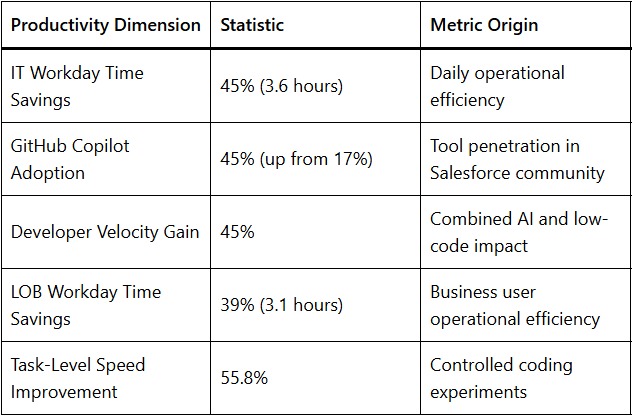
The implications of these statistics are profound for the Salesforce Software Development Lifecycle (SDLC). When task completion speed is analyzed in controlled environments, the impact is even more pronounced; for example, a randomized trial of developers using AI pair programmers showed a 55.8% reduction in the time required to complete complex coding tasks compared to those using traditional methods. This acceleration allows organizations to address growing backlogs and accelerate time-to-market for critical business applications without the traditional requirement of increasing developer headcount.
Technological Foundations: From Predictive Einstein to Agentforce
The acceleration of Salesforce development is predicated on the evolution of the platform’s native AI capabilities, which have transitioned from predictive analytics to generative assistance and, most recently, to autonomous agents. The foundation of this shift is the Einstein 1 Platform, which integrates unified customer data from Data Cloud with generative models protected by the Einstein Trust Layer.
The Evolution of Einstein for Developers
The platform’s specialized AI tool for technical professionals, formerly known as Einstein for Developers and now integrated into the Agentforce for Developers suite, provides context-aware assistance specifically tuned for the Salesforce metadata architecture. Unlike generic coding assistants, these tools are built on Salesforce’s custom CodeGen large language model, which understands the intricacies of the Apex programming language, Lightning Web Components (LWC), and the underlying multitenant database structure.
Apex, being a strongly typed, object-oriented language that runs in a multitenant environment, imposes specific constraints such as governor limits on CPU time, SOQL queries, and DML statements. AI-assisted tools like ApexGuru analyze these constraints in real-time, detecting critical anti-patterns and suggesting optimizations that prevent runtime failures. This capability ensures that as developers write code faster, they do not inadvertently introduce performance bottlenecks that are costly to remediate later in the SDLC.
Agentforce and the Shift to Autonomous Task Execution
The introduction of Agentforce represents a leap from assistive AI to agentic AI. While traditional copilots require the developer to initiate every prompt and review every line, agents are goal-oriented systems capable of making autonomous decisions and executing multi-step workflows. In the context of development, Agentforce Vibes a full-cycle AI-powered IDE plugin allows developers to convey high-level intent in natural language, which the system then translates into production-grade business logic.
Agentforce Vibes automates the generation of boilerplate Apex, complex Lightning components, and even the necessary test data for sandboxes. The “Vibe Codey” agent acts as a digital pair-programmer, capable of understanding metadata, generating tests, and analyzing security vulnerabilities before code is ever committed to a repository. This transition allows human developers to shift their focus from the “writing” of code to the “architecting” and “validation” of system logic, aligning with broader trends that show a 70% reduction in manual development tasks predicted by 2027.
Impact Across the Software Development Lifecycle (SDLC)
AI-driven improvements are distributed across every phase of the Salesforce SDLC, from initial requirements gathering to final deployment. By automating the “outer loop” of development supporting activities like documentation and testing AI allows the human brain to focus on the “inner loop” of creative problem-solving and logic design.
Requirements Engineering and Planning
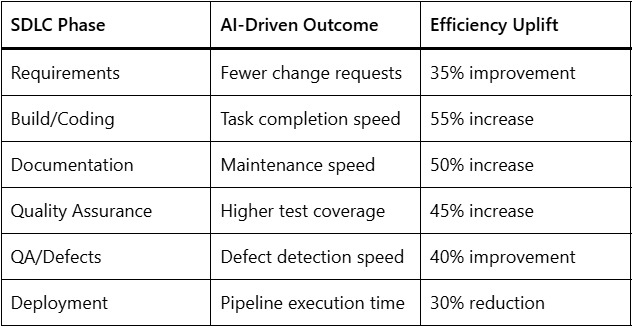
Traditionally, the translation of business goals into technical specifications is a major source of friction. AI tools now leverage Natural Language Processing (NLP) to convert unstructured business intent into structured requirements, user stories, and acceptance criteria. This shift has been shown to result in 35% fewer change requests by improving the initial clarity of requirements. Platforms like CoreIQ enable this “Smarter Requirements Engineering,” minimizing ambiguity and ensuring that the development team begins with a validated technical specification.
Coding and Build Efficiency
During the active coding phase, AI assistants provide inline code suggestions and autocompletion that account for the specific context of the Salesforce organization. For instance, a developer can prompt the system to “Create a REST API in Apex for inserting Contacts,” and the AI will output a complete class with proper annotations and DML handling. Beyond new code generation, gen AI increases the speed of documenting existing code for maintainability by 50% and accelerates code refactoring by 20-30%.
Automated Testing and Quality Assurance
One of the most persistent bottlenecks in Salesforce development is the requirement for 75% unit test coverage for Apex code. Agentforce for Developers significantly reduces this burden by automatically generating @isTest methods, mocks, and assertions based on the logic of the target class. Furthermore, AI-driven QA can generate test cases based on historical defects and code structures, leading to a 40% improvement in defect detection speed. This shift from reactive to proactive testing ensures that quality is “shifted left” in the development process, resolving issues earlier when they are less expensive to fix.
Internal Salesforce Engineering: A Case Study in Scale and Trust
The most compelling evidence of AI’s impact on development speed comes from Salesforce’s internal engineering organization, which consists of over 15,000 engineers. By operationalizing AI productivity tools at scale, the company has achieved a 94% internal adoption rate, demonstrating that AI-native engineering cultures are achievable within large-scale enterprises.
The Engineering 360 Dashboard and Metric Evolution
To manage this transition, Salesforce moved away from traditional metrics like lines of code or commit frequency, which do not capture the impact of AI. Instead, they developed the “Engineering 360” (Eng360) dashboard, powered by Salesforce Data Cloud and Tableau. This platform provides a centralized view of security, availability, quality, accessibility, and developer productivity across all services. One of the key findings from this implementation was a 35% increase in cycle time for teams that regularly operationalized these AI-driven insights.
The dashboard utilizes the “SPACE” metrics framework Satisfaction, Productivity, Activity, Collaboration, and Efficiency to provide a holistic view of team health. By tracking these metrics, engineering leaders can identify exactly where friction exists and deploy AI solutions to remediate it, such as automating the rotation of certificates and secrets, which Salesforce has achieved at a 100% rate.
Operational Efficiency and the COIN Score
Financial governance of these AI tools is managed through the COIN (Cost Opportunity Index) score, which measures the efficiency of cloud spend for internal services. The score is calculated as follows:
$$\text{COIN Score} = 1 – \left( \frac{\text{Savings Opportunities}}{\text{Total Cost}} \right)$$
This metric allows engineering teams to benchmark their cost efficiency across different business units, ensuring that the rapid adoption of AI does not lead to over-provisioning or redundant application spend. At Salesforce, scores are monitored weekly, providing transparency to thousands of engineers regarding their team’s performance.
Economic Implications: The Digital Labor Movement
The acceleration of development is a critical component of what Salesforce CEO Marc Benioff describes as the “digital labor” movement. This movement posits that AI and agentic technology can address global labor shortages by supplementing and mimicking human cognitive functions. The economic scale of this shift is immense, with IDC predicting that cumulative spending on digital labor will reach $3.34 trillion by 2030, generating a global economic impact of $13 trillion.
Job Transformation and Creation
Salesforce itself reduced its customer support workforce by 4,000 (roughly 45%) by replacing repetitive tasks with AI agents the broader impact is one of role transformation rather than simple elimination. IDC reports that new job creation (23%) is currently outpacing role elimination (14%), with a significant net gain of almost 12 million jobs expected between 2022 and 2028.
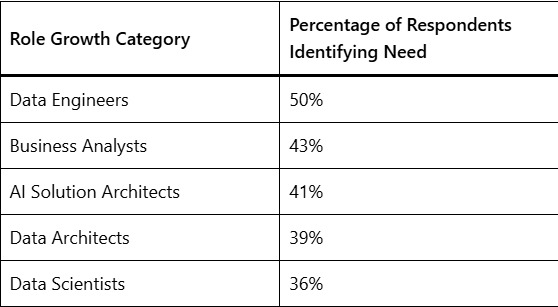
As AI handles more of the “writing” of code, the demand shifts toward professionals who can manage the “data foundation” of these systems. This includes data engineers and AI architects who ensure that the unified customer data used to ground AI responses is trustworthy and accurate.
ROI and Business Outcomes
The business value of AI-powered development extends beyond the IT department. Salesforce’s “Customer Zero” initiative demonstrated that AI-enabled development helped identify $25 million in sales value through unified data and AI-driven insights. Furthermore, the automation of customer service through Agentforce has saved over 35,000 support hours, achieving an 85% resolution rate from autonomous service agents. These outcomes illustrate how the 45% speed improvement in development directly translates into revenue growth and cost reduction across the entire enterprise.
Data Readiness and the Trust Barrier
The effectiveness of AI in accelerating Salesforce development is ultimately dependent on the quality and accessibility of an organization’s data. The “Data Pioneer” segment organizations that have successfully unified their data landscape report outperforming their peers in profitability and revenue growth. Specifically, 61% of these leaders state that Salesforce helped them achieve a faster time to market through advanced data capabilities.
The Integration Gap
A significant barrier remains in the “integration gap.” Despite the high adoption of AI, many organizations find that only a fraction of their enterprise applications are connected. On average, organizations use 897 applications, but those utilizing AI agents typically use 1,103 a 45% increase that reflects the higher complexity of agentic infrastructures. Connectivity challenges are cited by 95% of IT leaders as a primary obstacle to effective AI deployment, emphasizing that robust integration via platforms like MuleSoft is a prerequisite for realizing AI-driven productivity gains.
The Einstein Trust Layer
Security remains a paramount concern, as 64% of workers state they would use generative AI more if they knew it was safe. Salesforce addresses this through the Einstein Trust Layer, which provides a “secure by design” architecture. This layer ensures that prompts and customer data are encrypted and isolated, preventing the “leakage” of sensitive org metadata into public large language models. This allows developers to use AI assistants for complex tasks like vulnerability scanning and code generation without compromising enterprise data privacy standards.
Research Frontiers: The SFR-Iterative Models and TreeBoN
Salesforce Research continues to push the boundaries of how AI can assist in development through the creation of state-of-the-art models like the SFR-Iterative-DPO-LLaMA-3-8B-R. This model is designed specifically for high-performance instruction following and code generation, outperforming larger proprietary models in common industry benchmarks.
Iterative Alignment and Tree Search
The speed of AI responses is being further optimized through frameworks like “TreeBoN” (Tree-search Best-of-N). Traditional Best-of-N sampling generates multiple separate responses and selects the best one, but this is computationally expensive and slow. TreeBoN integrates a speculative tree-search strategy that iteratively branches and prunes low-quality paths in real-time, maintaining high output quality while significantly reducing computational overhead and latency. This ensures that AI tools for developers remain “speedy” enough to be used in interactive, real-time coding environments.
Future Outlook: The Agentic Enterprise
As the Salesforce platform moves toward 2030, the role of AI is expected to transition from an “add-on” to a fundamental architectural component. The “Productivity Paradox” where developers feel faster but may sometimes take longer due to debugging AI-generated code is expected to resolve as models become more reliable and developers gain proficiency in “prompt engineering”.
The ultimate goal is the “Agentic Enterprise,” where humans and AI agents work together in a state of “superagency”. In this model, the 45% improvement in development speed becomes the foundation for a wider organizational transformation characterized by hyper-personalization, autonomous service, and continuous innovation. By automating the repetitive and mundane, AI allows the human workforce to reclaim its capacity for high-value strategic work, ensuring that the future of business is both faster and more human-centric.
The quantifiable impact of AI on Salesforce development is no longer a matter of speculation. From the 45% reduction in workday friction to the 55% increase in task completion speed, the data confirms a radical shift in how technology is built and deployed. For the professional peers managing these transitions, the challenge lies not only in adopting the tools but in preparing the data foundations and cultural frameworks necessary to support a 10,000-word vision of technological excellence.