

How Agent AI is reshaping Salesforce workflows in 2025
Introduction: Salesforce workflows in 2025
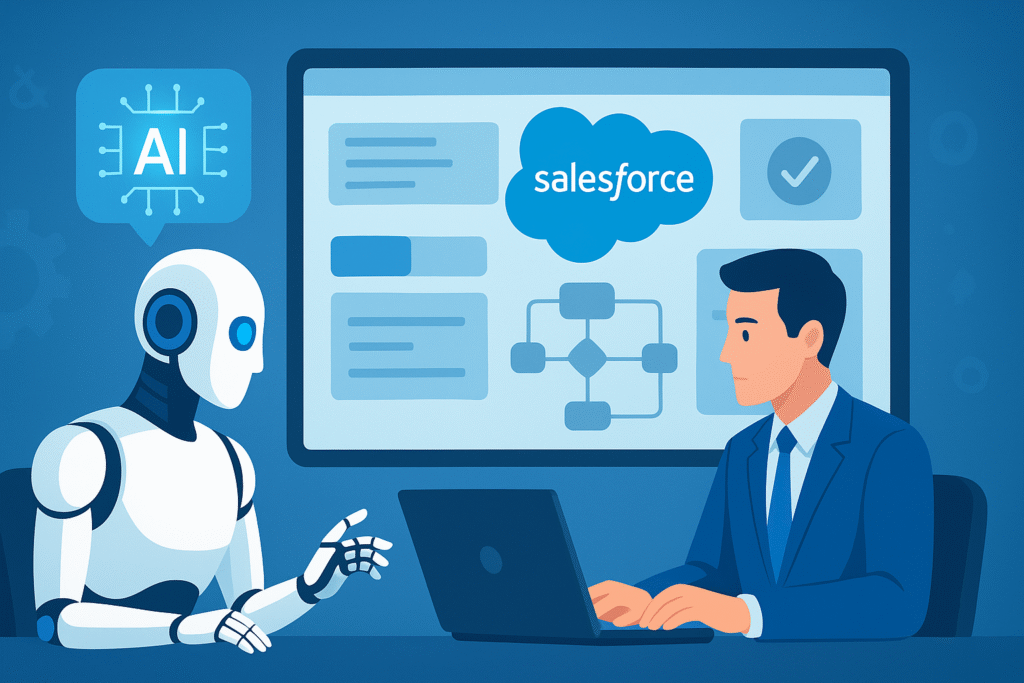
In 2025, Salesforce continues to lead the AI-powered CRM revolution with its latest innovation, Agent AI. Einstein GPT And building on a data cloud foundation, Agent AI brings automation, personalization, and intelligence to every Salesforce workflow. It’s not just an accessory; it is a dynamic problem-solver that is transforming how businesses interact with customers, manage data, and perform everyday tasks.
Table of Contents
1. What Is Agent AI?
Agent AI is Salesforce’s next-generation intelligent automation framework, designed to help users manage complex workflows through natural language, predictive insights, and real-time automation. It integrates deeply with the Salesforce ecosystem, including Sales Cloud, Service Cloud, Marketing Cloud, and Data Cloud, allowing teams to work faster and smarter.
At its core, agent AI enables users to describe in plain language what they want to accomplish, and it automatically creates, optimizes, or triggers the appropriate workflow behind the scenes. From automating lead follow-ups to providing intelligent recommendations during service calls, agent AI is redefining functionality.
2. The Evolution from Einstein GPT to Agent AI
When Einstein GPT It laid the groundwork for productive capabilities within Salesforce Agent AI took it a step further. Rather than just producing content or summaries, agent AI acts as a digital co-pilot that understands context, analyzes business data, and takes action.
In 2025, this evolution represents a shift from passive AI assistance to active workflow orchestration. Agent AI can combine data cloud insights with flow automation, helping teams anticipate customer needs and deliver personalized experiences without trying to do it themselves. For example, a service agent can rely on agent AI to detect customer sentiment, retrieve relevant case histories, and suggest optimal solutions in real time.
3. Key Capabilities Transforming Workflows
A. Workflow automation through natural language
Users can now type or speak their intentions—such as “Create a follow-up task for leads with high intent from last week”—and Agent AI automatically creates or updates the flow that takes the action. This eliminates the need for complex setup and technical configuration.
B. Real-time decision
With data cloud integration, agent AI analyzes customer data in real time to determine the best next action. For instance, if a customer shows a churn risk, AI can trigger personalized retention workflows or alert the sales team immediately.
C. Context-awareness aids
Agent AI recognizes context from past interactions, CRM history, and external data sources. This allows sales reps, marketers, and service agents to work with relevant insights without switching screens or running reports.
d. Continuous optimization
Agent AI learns from workflow performance over time, identifying inefficiencies and suggesting improvements. For example, if certain automated emails yield low engagement, the system can propose changes in timing or content based on predictive analytics.
4. Impact on Different Salesforce Clouds
Sales Cloud
Sales teams benefit from intelligent lead scoring, follow-up reminders, and opportunity insights powered by agent AI. By automating repetitive tasks, reps spend more time closing deals and less time entering information. Agent AI also predicts deal risks and recommends individual actions for each stage of the pipeline.
Service Cloud
Customer support sees a major transformation with AI-powered case routing, sentiment analysis, and knowledge suggestions. Agent AI ensures that agents handle complex issues efficiently while routine requests are automated through AI bots or digital self-service.
Marketing Cloud
In marketing, agent AI improves the customer journey using predictive analytics. It automates segmentation, content creation, and performance optimization, enabling marketers to launch campaigns that continuously adapt to customer behavior in real time.
Data cloud
Agent AI leverages aggregated customer profiles from the data cloud to personalize each engagement. It ensures that automation flows are driven by accurate, current, and consistent data, reducing silos and enhancing decision-making across departments.
5. Empowering Admins and Developers
Salesforce admins and developers also benefit greatly with Agent AI. Tasks that once required manual flow design, Apex coding, or report generation can now be generated through natural language prompts. Developers can focus on innovation while Agent AI takes care of the groundwork—from writing code snippets to testing automation.
On the other hand, administrators can ask Agent AI to audit workflow performance, detect conflicts, or generate reports on system usage. This significantly reduces the time spent on maintenance and ensures better governance.
6. Data Security and Ethical AI
Salesforce continues to prioritize trust and compliance in its AI expansion. Agent AI adheres to the Einstein Trust Layer, which ensures that all data processed by AI is secure, auditable, and compliant with global regulations. System AI keeps enterprise data within the confines of Salesforce while maintaining transparency in decision-making. This boosts confidence in businesses adopting automation on a large scale.
7. The Future of Workflows in 2025 and Beyond
By 2025, the integration of agent AI into Salesforce had marked a new era of intelligent CRM. It empowers teams to act faster, predict outcomes, and personalize engagement at scale all through automation that feels human.
As organizations adapt to this AI-first ecosystem, workflows are no longer static or rule-based. Instead, they are dynamic, data-driven, and self-evolving, driven by continuous learning and feedback from agent AI. Businesses that embrace this change gain a competitive edge through improved productivity, increased customer satisfaction, and faster innovation cycles.
Key Takeaway:
Agent AI is not just a feature — it’s the driving force behind Salesforce’s new intelligent automation era. By bridging the gap between human intent and machine action, it transforms everyday workflows into intelligent, predictive, and efficient systems. In 2025, Salesforce users across industries are experiencing the future of CRM — where automation meets intelligence, and every workflow works smarter, not harder.