

Future of CRM Assistants in Salesforce Ecosystem
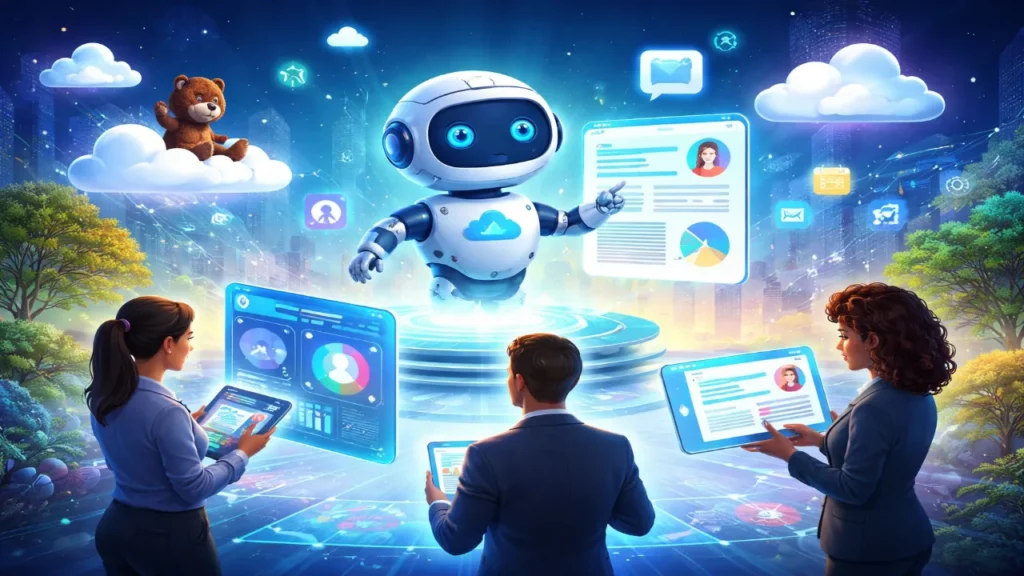
Customer Relationship Management has evolved far beyond contact storage and pipeline tracking. In recent years, artificial intelligence has begun reshaping how businesses interact with customers, automate workflows, and empower teams. Within the Salesforce ecosystem, CRM assistants are quickly becoming central to this transformation. The future of CRM assistants is not just about automation—it is about intelligence, autonomy, and deeply contextual engagement across every business function.
This blog explores how CRM assistants are evolving, what technologies are driving their growth, and what businesses can expect in the coming years.
Table of Contents
The Shift from Tools to Intelligent Assistants
Traditional CRM systems were reactive. Sales reps logged calls, support agents updated cases, and marketers tracked campaigns manually. Automation rules helped streamline repetitive tasks, but decision-making still relied heavily on human effort.
Today, CRM assistants are shifting from rule-based automation to intelligent guidance. Instead of simply storing data, they analyze patterns, predict outcomes, and recommend next steps. The integration of AI within Salesforce is turning CRM from a passive database into an active business partner.
CRM assistants now:
- Suggest follow-up actions after meetings
- Predict deal closure probabilities
- Recommend cross-sell or upsell opportunities
- Automatically summarize conversations
- Draft emails and responses
This shift marks the beginning of a more autonomous CRM environment.
AI-Powered Intelligence at the Core
The future of CRM assistants in Salesforce is deeply tied to advanced AI technologies. With innovations like predictive analytics, machine learning, and generative AI, assistants are becoming proactive rather than reactive.
Predictive Insights
CRM assistants can analyze historical sales data, customer engagement metrics, and service patterns to forecast outcomes. For example:
- Which leads are most likely to convert?
- Which customers are at risk of churn?
- What product recommendations have the highest success rate?
These insights allow teams to focus on high-impact actions instead of guesswork.
Generative AI Capabilities
Generative AI enhances productivity by creating content on demand. Within Salesforce, AI-driven assistants can:
- Draft personalized sales emails
- Generate case summaries
- Create marketing campaign outlines
- Produce knowledge base articles
This reduces manual effort while maintaining personalization at scale.
The Rise of Autonomous Agents
The next phase of CRM assistants involves autonomous decision-making. Rather than only suggesting actions, future assistants will execute tasks based on defined guardrails.
For example:
- Automatically routing leads to the best-performing rep
- Adjusting campaign budgets based on performance metrics
- Escalating support cases based on sentiment analysis
- Scheduling follow-ups without manual input
Salesforce’s AI vision, represented by tools like Einstein AI, is paving the way for these intelligent systems to operate securely within enterprise environments.
Autonomous CRM assistants will not replace employees; instead, they will augment human capabilities by handling routine tasks and surfacing strategic insights.
Deep Integration Across Clouds
The Salesforce ecosystem includes multiple clouds such as Sales Cloud, Service Cloud, Marketing Cloud, and Commerce Cloud. The future of CRM assistants lies in cross-cloud intelligence.
Unified Customer View
CRM assistants will unify data across departments, creating a 360-degree view of each customer. This enables:
- Sales teams to see support history before calls
- Service agents to view marketing interactions
- Marketers need to understand purchase behavior
With a centralized intelligence layer, decisions become more informed, and customer experiences more personalized.
Context-Aware Interactions
Future assistants will understand the context of each interaction. For example:
- During a support case, the assistant may suggest upsell opportunities only if customer sentiment is positive.
- During a sales call, it may recommend tailored talking points based on past purchases.
This level of contextual awareness enhances both efficiency and customer satisfaction.
Conversational Interfaces and Voice Assistance
CRM assistants are increasingly conversational. Instead of navigating dashboards, users can interact with the system through natural language.
Imagine asking:
- “Show me deals closing this month above $50K.”
- “Summarize the last five interactions with this account.”
- “What are my top priorities today?”
Conversational AI reduces friction and improves user adoption. Voice-enabled CRM interactions may also become common, particularly for field sales and service teams who need hands-free access.
This natural interaction layer makes CRM more accessible to non-technical users and executives alike.
Personalization at Scale
Personalization is no longer optional. Customers expect relevant communication and timely responses. CRM assistants powered by AI will refine personalization strategies by analyzing behavioral and transactional data.
Future capabilities may include:
- Hyper-personalized product recommendations
- Real-time email content adaptation
- Automated journey adjustments based on engagement
- Dynamic pricing suggestions
Within the Salesforce ecosystem, assistants can monitor engagement signals and automatically refine strategies in real time.
The result is a CRM that not only stores customer data but actively uses it to create meaningful interactions.
Real-Time Decision Intelligence
Speed is critical in competitive markets. CRM assistants of the future will operate in real time, identifying risks and opportunities instantly.
Examples include:
- Flagging stalled deals and suggesting recovery tactics
- Identifying support case sentiment shifts
- Recommending next-best actions during live calls
- Alerting managers about performance trends
By embedding intelligence into daily workflows, CRM assistants reduce response times and improve business agility.
Security, Trust, and Ethical AI
As AI becomes central to CRM operations, trust becomes essential. Enterprises require transparency, data security, and compliance.
Future CRM assistants will incorporate:
- Data masking and access controls
- Clear audit trails for AI decisions
- Explainable AI models
- Bias monitoring and fairness checks
Salesforce has consistently emphasized trust as a core value, and AI assistants must operate within strict governance frameworks to maintain customer confidence.
Responsible AI will not just be a feature—it will be a requirement.
Impact on Sales Teams
CRM assistants will redefine the role of sales professionals. Instead of spending hours on data entry and reporting, reps will focus on relationship-building and strategy.
Key transformations include:
- Automated call logging and meeting summaries
- Smart pipeline prioritization
- AI-generated opportunity insights
- Guided selling frameworks
Managers will benefit from predictive dashboards that highlight coaching opportunities and performance gaps.
Ultimately, CRM assistants act as digital co-pilots, improving both efficiency and effectiveness.
Impact on Service Teams
Customer service is another area where CRM assistants will drive major change.
Future service capabilities:
- Instant case categorization
- AI-suggested resolution steps
- Automated response drafting
- Sentiment-based escalation
By reducing resolution times and improving consistency, assistants enhance customer satisfaction while lowering operational costs.
Self-service portals powered by AI assistants will also become more intuitive, enabling customers to find answers quickly.
Impact on Marketing Teams
Marketing teams will benefit from AI-driven campaign optimization and audience segmentation.
CRM assistants can:
- Analyze engagement trends
- Identify high-performing segments
- Suggest content strategies
- Automate journey branching
Campaign performance will improve through data-driven experimentation and continuous optimization.
The future points toward fully adaptive marketing ecosystems where assistants manage targeting, timing, and personalization automatically.
Developer and Admin Opportunities
As CRM assistants evolve, Salesforce developers and administrators will play a critical role in configuring and optimizing these systems.
Future opportunities include:
- Designing AI-driven workflows
- Setting guardrails for autonomous actions
- Integrating external data sources
- Customizing AI models for industry-specific use cases
Admins will shift from managing fields and layouts to managing intelligence layers and automation frameworks.
This evolution creates new career paths focused on AI configuration and governance within the Salesforce ecosystem.
Industry-Specific AI Assistants
The future of CRM assistants will also be industry-focused. Healthcare, finance, retail, and manufacturing each have unique needs.
Examples:
- Healthcare assistants suggest patient engagement strategies
- Financial services assistants monitoring compliance
- Retail assistants predicting seasonal demand
- Manufacturing assistants optimizing supply chain relationships
Industry-specific intelligence enhances accuracy and relevance.
Challenges Ahead
Despite the promising future, challenges remain:
- Data Quality Issues
AI assistants rely on clean, structured data. Poor data quality can reduce accuracy. - User Adoption
Teams must trust and understand AI recommendations. - Integration Complexity
Businesses often use multiple tools beyond Salesforce. - Ethical Considerations
AI decisions must remain transparent and unbiased.
Organizations that address these challenges proactively will gain competitive advantages.
The Road Ahead
The future of CRM assistants in the Salesforce ecosystem is intelligent, autonomous, and deeply integrated. These assistants will:
- Automate routine tasks
- Deliver predictive insights
- Personalize customer interactions
- Enable real-time decision-making
- Strengthen cross-team collaboration
As AI technologies continue to mature, CRM assistants will evolve from supportive tools into strategic business partners.
Businesses that embrace this transformation will not only improve efficiency but also create richer customer experiences and stronger long-term relationships.
In the coming years, CRM will no longer be just a system of record—it will become a system of intelligence, powered by AI-driven assistants that shape every customer interaction.