

Data Cloud vs Traditional CDPs: Why 2026 Is the Turning Point
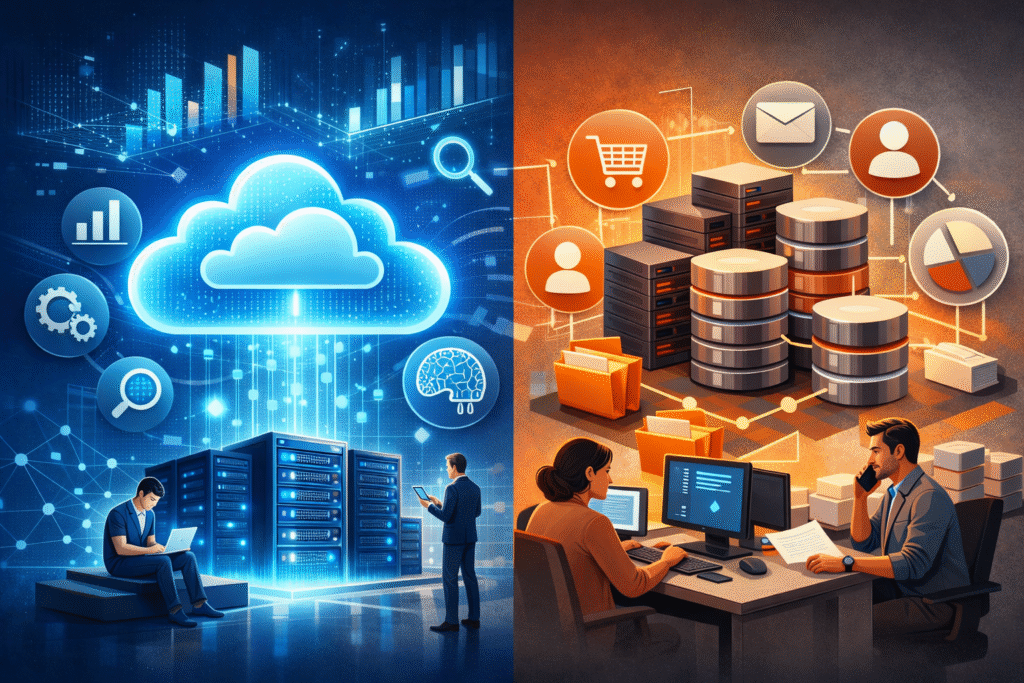
In 2026, the landscape of customer data management is evolving faster than ever. Businesses are increasingly dependent on data to power personalized experiences, streamline operations, and drive strategic decisions. Two major approaches have emerged as front-runners in managing customer data: Data Cloud platforms and Traditional Customer Data Platforms (CDPs). While both aim to centralize and activate customer data, they differ significantly in architecture, capabilities, flexibility, and future readiness.
This blog explores these differences, why 2026 is a turning point, and how organizations must rethink their data strategy to stay competitive.
Table of Contents
Introduction: Data Cloud vs Traditional CDPs
Traditional CDPs have been widely adopted to unify customer data from various sources websites, mobile apps, CRM systems, email platforms, and more. They aggregate this data into a cohesive profile that marketing and analytics teams use to personalize campaigns, improve segmentation, and enhance customer insights.
However, as customer interactions grow more complex and data volumes explode, traditional CDPs are showing limitations. Enter Data Cloud a next-generation data platform that goes beyond CDP capabilities by offering deeper integration, broader data versatility, real-time capabilities, and scalable analytical intelligence.
What Is a Traditional CDP?
A Traditional Customer Data Platform is a software solution designed to:
- Collect customer data from various channels
- Unify that data into persistent customer profiles
- Segment audiences for marketing and personalization
Core Characteristics of Traditional CDPs
- Marketing-First Focus: Built primarily for marketing teams to deliver consistent messaging and customer experiences.
- Customer Profile Creation: Persistent identity resolution across devices or channels.
- Segmentation & Activation: Segment audiences and activate them in marketing channels.
- User-Friendly Interfaces: Designed so non-technical users can manage data segmentation and campaign workflows.
Traditional CDPs excel in enabling marketers to deliver personalized campaigns based on unified customer profiles. They simplified workflows and democratized customer data access outside traditional IT and analytics teams.
Limitations of Traditional CDPs
However, as business needs evolve:
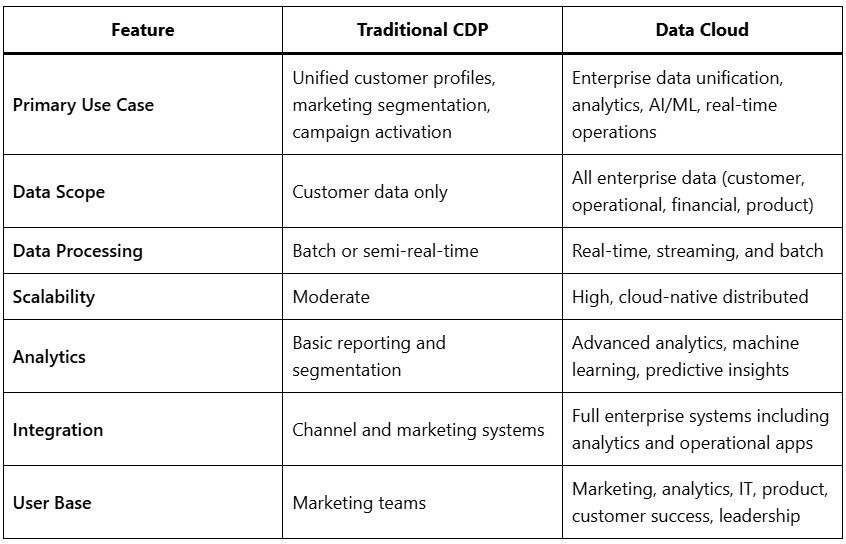
- Data Scope is Narrow: Primarily focused on marketing signals; limited support for enterprise-wide operational, financial, or product usage data.
- Rigid Data Models: Many CDPs require predefined schemas and struggle with diverse or unstructured datasets.
- Limited Real-Time Analytics: Often operate with delays that hinder milliseconds-based personalization in digital experiences.
- Scaling Challenges: Large enterprises need scalable solutions that support complex analytical workloads beyond CDP’s design.
These constraints have accelerated the need for a more scalable and versatile platform.
What Is Data Cloud?
A Data Cloud is a unified platform that centralizes all enterprise data structured, semi-structured, and unstructured across the organization. It goes far beyond the customer profile, supporting advanced analytics, AI/ML, operational applications, and real-time data delivery.
Key Traits of Data Cloud
- Universal Data Ingestion: Capable of ingesting data from every corner of an organization CRM, sales, service, IoT sensors, operational systems, third-party sources, and more.
- Real-Time Processing: Supports streaming data and live analytics, delivering insights at the moment decisions need to be made.
- Scalable Architecture: Built on distributed, cloud-native infrastructure to handle massive data volumes and complex workloads.
- AI/ML Integration: Extends support for predictive analytics, machine learning model training, and deployment.
- Cross-Functional Use Cases: Supports marketing, sales, finance, product, customer service, and strategic planning simultaneously.
What Makes Data Cloud Different
- Traditional CDPs are marketing-centric; Data Cloud is enterprise-wide.
- Data Clouds handle diverse and complex datasets, not just customer data.
- Data Clouds support advanced analytical workloads, predictive insights, and real-time actions.
In essence, Data Cloud is less a one-off tool and more of a foundational platform for the data-driven enterprise.
Comparing Data Cloud and Traditional CDPs
Why 2026 Is a Turning Point
1. Increasing Complexity of Customer Interactions
In 2026, customer engagement channels continue to diversify: mobile, web, in-app experiences, voice interfaces, IoT devices, and social platforms generate data faster than ever. Traditional CDPs struggle to assimilate and act on this deluge in real time.
2. Real-Time Demands Are Non-Negligible
Organizations now expect personalization that responds instantly to customer behavior—whether it’s recommending products mid-session or adapting offers based on context. Traditional CDPs, which often rely on batch processing, cannot meet these real-time expectations. Real-time data streaming and event processing in Data Cloud change this game completely.
3. AI and Machine Learning Are Mainstream
AI and predictive analytics have shifted from experimentation to mission-critical tools. Companies increasingly use ML models for churn prediction, lifetime value forecasting, and hyper-personalization. Data Cloud’s support for large-scale analytics and model deployment embeds intelligence deep into operations.
4. Breaking Down Data Silos is Critical
Enterprise leaders increasingly recognize that siloed data hurts performance. Data Cloud dissolves barriers between systems marketing, sales, finance, operations so every team can leverage the same trusted data foundation. Traditional CDPs can unify customer data but don’t solve broader enterprise fragmentation.
5. Data Privacy and Governance Are Non-Negotiable
With data privacy regulations tightening globally, having centralized governance and compliance capabilities is essential. Data Cloud platforms embed governance frameworks that extend across datasets and use cases something traditional CDPs only partially support.
6. Enterprise Demand for Unified Intelligence
Leadership teams today don’t want separate, disconnected insights for marketing, finance, or service—they want enterprise intelligence. Data Cloud becomes the nerve center for data strategy, making it indispensable for organizations scaling data initiatives.
Use Cases: Traditional CDP vs Data Cloud
Traditional CDP Use Cases
- Email and digital campaign targeting
- Customer segmentation for marketing activation
- Single customer view for loyalty programs
- Cross-channel personalization in advertising
These are essential but mostly restricted to the marketing domain.
Data Cloud Use Cases
- Predictive churn and revenue forecasting
- Real-time personalization across web, app, and in-store
- Product analytics and usage pattern identification
- Cross-department insights for customer success and finance
- AI-driven recommendations and dynamic content delivery
- Operational analytics for supply chain, delivery routing, and pricing optimization
Data Cloud supports holistic business decisions, not just targeted messaging.
Challenges and Considerations
While Data Cloud represents the future, it’s not a simple drop-in replacement for traditional CDPs. Organizations must consider:
1. Data Maturity
Companies with limited data architecture may need to invest in governance, integration, and talent before fully leveraging Data Cloud.
2. Change Management
Data Cloud adoption often involves cultural and process changes cross-team collaboration, redefined workflows, and new skill sets.
3. Cost and Complexity
Advanced platforms may require higher investment and technical expertise. But these costs often pay off through agility, scalability, and strategic value.
4. Phased Adoption
Many organizations will run Data Cloud alongside existing CDPs during transition phases. This hybrid approach helps preserve existing investments while unlocking advanced capabilities.
Conclusion: Future-Proofing with Data Cloud
In 2026, the evolution of customer expectations, real-time engagement needs, AI-driven strategies, and enterprise intelligence demands make the shift from traditional CDPs to Data Cloud both logical and necessary. Traditional CDPs remain valuable for specific marketing use cases, but they no longer suffice as the central nervous system for data-driven organizations.