

Cross-Cloud Automation Driving Next-Gen Customer Journeys

Cross-Cloud Automation is revolutionizing how businesses craft seamless, personalized customer journeys across multiple cloud platforms. This approach leverages integrated automation tools to unify data, AI, and workflows, driving next-generation experiences that boost engagement and revenue.
Table of Contents
What is Cross-Cloud Automation?
Cross-cloud automation refers to the orchestration of processes across disparate cloud environments, such as Salesforce Marketing Cloud, Data Cloud, Service Cloud, and third-party systems like ERPs or CDPs. It enables real-time data syncing and automated triggers that adapt customer interactions dynamically.
By breaking down silos, businesses create unified customer profiles from web, CRM, and service signals, ensuring consistent experiences from awareness to loyalty. Key enablers include integration middleware (iPaaS) and AI engines for predictive decision-making.
Driving Next-Gen Customer Journeys
Next-gen customer journeys prioritize hyper-personalization and omnichannel consistency over linear funnels. Automation triggers actions based on behaviors like cart abandonment or service cases, delivering the right message via email, mobile, ads, or onsite personalization.
Salesforce’s Marketing Cloud Next exemplifies this by unifying people, data, and channels for adaptive journeys measured against pipeline and revenue. Einstein AI selects optimal content and timing, while event triggers react in seconds to reduce churn.
Core Components
- Customer Data Platforms (CDPs): Centralize data from CRM, apps, and POS for holistic profiles that update in real-time.
- Workflow Tools: Map journeys and automate responses based on user actions or lifecycle stages.
- AI Analytics: Predict patterns, recommend engagements, and optimize with propensity scoring.
- Orchestration Engines: Coordinate cross-channel flows with decisioning for step-level adaptability.
- Governance Layers: Enforce consent, suppression rules, and taxonomy for scalable compliance.
These elements form a maturity matrix, evolving from ad-hoc silos to operationalized systems tracked by KPIs like match rate and ROMI.
Key Benefits
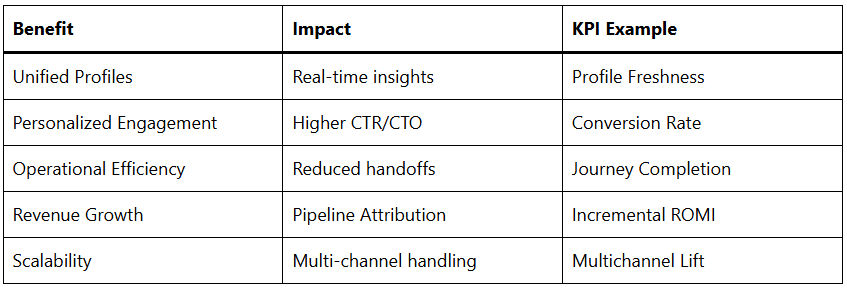
Cross-cloud automation enhances customer experiences by anticipating needs with contextual messaging, lifting conversions through timely personalization. It cuts manual work, minimizes errors, and scales interactions across touchpoints effortlessly.
Businesses see improved retention via proactive outreach and cross-cloud alignment, such as suppressing marketing during open service cases. Revenue attribution ties journeys to outcomes, with holdout experiments proving incremental lift.
Real-World Implementation
Start by connecting data sources into a CDP, unifying profiles with identity resolution and consent management. Segment audiences on behaviors (e.g., viewed products, sales stages), then orchestrate via triggers like browsing events or case updates.
Personalize with AI-ranked offers and measure via cohorts linking to bookings or churn reduction. A B2B example: Comcast Business unified Marketing, Sales, and Service Clouds to shorten demo-to-close cycles and apply service-aware suppressions.
Challenges and Solutions
Data silos and consent complexity hinder adoption, but iPaaS middleware ensures seamless flows. Legacy systems require middleware for integration, while AI governance prevents over-personalization risks.
Feedback loops and monitoring refine journeys iteratively, with cross-team ownership (RevOps, Marketing Ops) accelerating maturity. Strategic partners aid implementation, optimizing for platforms like Salesforce Marketing Cloud.
Future Outlook
As AI advances, cross-cloud automation will evolve toward fully autonomous journeys with agentic decisioning. Expect deeper zero-party data integration and predictive orchestration, powering loyalty in digital-first ecosystems. Businesses adopting now gain a competitive edge in retention and growth.