

Autonomous CRM in 2026: What Salesforce AI Means for Business
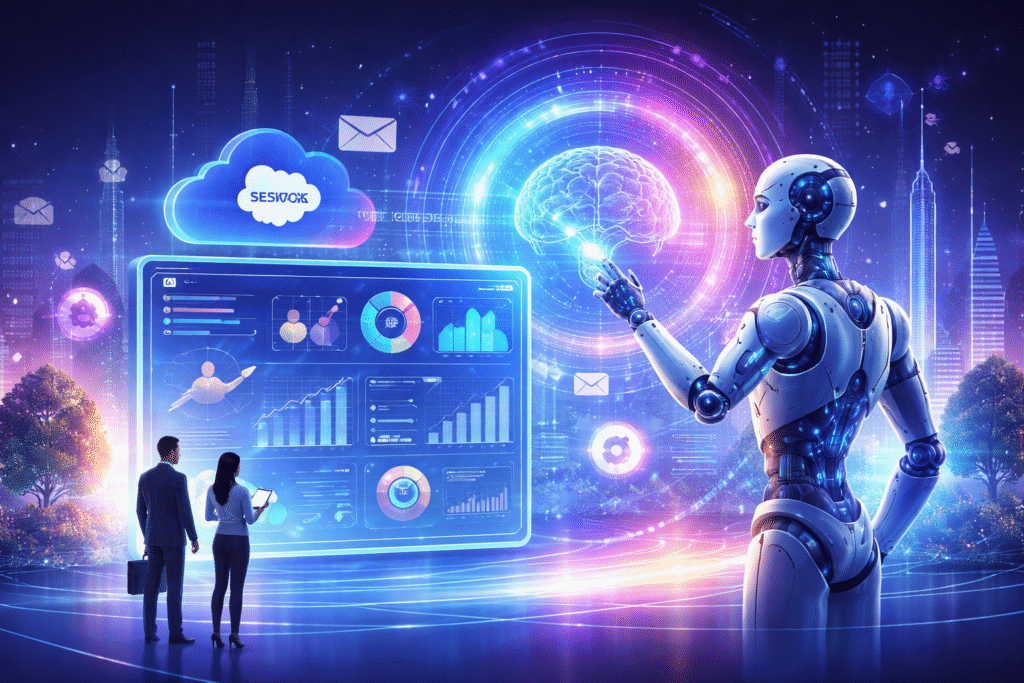
Introduction: Autonomous CRM in 2026
Customer Relationship Management (CRM) has come a long way. What began as a simple system for storing customer data has evolved into an intelligent platform that guides sales, marketing, and service teams. By 2026, CRM is no longer just “smart” it is becoming autonomous.
Autonomous CRM represents a major shift in how businesses operate. Instead of humans constantly configuring workflows, running reports, or triggering campaigns, AI-driven systems like Salesforce AI and Agentforce are now capable of making decisions, taking actions, and optimizing outcomes with minimal human intervention.
For businesses, this shift is transformative. It means faster decision-making, hyper-personalized customer experiences, reduced operational effort, and a new way for teams to focus on strategy rather than repetitive execution.
In this blog, we’ll explore what Autonomous CRM truly means, how Salesforce AI is leading this change, and what businesses should expect by 2026.
What Is Autonomous CRM?
Autonomous CRM goes beyond traditional automation. While automation follows predefined rules (“if this happens, do that”), autonomy means the system can:
- Understand context
- Learn from data and behavior
- Make decisions independently
- Take action across systems
- Continuously improve outcomes
In simple terms, an autonomous CRM doesn’t just assist users — it acts like a digital team member.
Salesforce’s vision of Autonomous CRM is powered by advanced AI models, real-time customer data, predictive analytics, and AI agents that work across sales, marketing, service, and commerce. These systems don’t replace humans; instead, they handle execution while humans focus on creativity, strategy, and relationship-building.
Why 2026 Is a Turning Point for CRM
Several trends are converging to make 2026 a critical year for Autonomous CRM:
- Explosion of Customer Data
Businesses now collect data from websites, apps, emails, social platforms, IoT devices, and customer support interactions. Managing and acting on this data manually is no longer realistic. - Rising Customer Expectations
Customers expect instant responses, personalized experiences, and consistent interactions across channels. Delays or generic messaging can quickly lead to churn. - Advances in AI and Large Language Models
AI systems can now understand natural language, generate content, reason through complex scenarios, and learn continuously making autonomy possible at scale. - Operational Complexity
Sales, marketing, and service teams use dozens of tools. Autonomous CRM acts as a unifying intelligence layer, coordinating actions across systems.
Salesforce recognized these challenges early, positioning its AI ecosystem to move CRM from “reactive” to “self-driving.”
Salesforce AI: The Foundation of Autonomous CRM
Salesforce AI is not a single feature — it’s a comprehensive intelligence layer embedded across the Salesforce platform. By 2026, Salesforce AI combines several key components:
1. Unified Customer Data
At the core is Salesforce’s ability to unify customer data across clouds Sales Cloud, Service Cloud, Marketing Cloud, Commerce Cloud, and Data Cloud. Autonomous CRM depends on having a single, trusted source of truth.
AI continuously analyzes this data to detect patterns, predict intent, and identify opportunities that humans might miss.
2. Predictive and Generative AI
Salesforce AI uses predictive models to forecast outcomes such as:
- Which leads are most likely to convert
- Which customers are at risk of churn
- Which products a customer is likely to buy next
Generative AI adds another layer by creating:
- Personalized email and message content
- Sales call summaries and follow-ups
- Knowledge base articles and service responses
This combination allows CRM systems not just to predict what will happen but to act on it automatically.
3. Agentforce and AI Agents
One of the most important developments is the rise of AI agents. Salesforce’s Agentforce enables autonomous agents that can:
- Engage with customers via chat, email, or messaging
- Route and resolve service cases
- Trigger marketing journeys
- Update CRM records automatically
- Coordinate tasks across teams
These agents operate within defined business rules and ethical boundaries, ensuring trust and control while still delivering speed and scale.
How Autonomous CRM Transforms Sales
Sales teams are often overwhelmed by administrative tasks logging activities, updating opportunities, sending follow-ups, and preparing forecasts. Autonomous CRM changes this completely.
Smarter Lead Management
AI automatically scores and prioritizes leads based on behavior, intent signals, and historical performance. High-value leads are routed instantly to the right sales rep, while low-intent leads are nurtured automatically.
Autonomous Deal Progression
Autonomous CRM can:
- Detect stalled deals
- Recommend next-best actions
- Automatically send personalized follow-ups
- Update opportunity stages based on customer engagement
Sales reps spend less time managing pipelines and more time building relationships.
AI-Driven Forecasting
Instead of static forecasts, Salesforce AI continuously updates predictions based on real-time data, giving leaders more accurate visibility into revenue and risks.
Autonomous CRM in Marketing: From Campaigns to Conversations
Marketing is shifting from batch campaigns to continuous, real-time engagement. Autonomous CRM plays a critical role in this evolution.
Real-Time Personalization
Autonomous systems adjust messaging, offers, and timing automatically based on customer behavior. Every interaction becomes context-aware and personalized at scale.
Self-Optimizing Journeys
Instead of manually adjusting campaigns, AI agents test variations, learn what works, and optimize journeys without human intervention. Performance improves continuously.
Content at Scale
Generative AI creates subject lines, email copy, push notifications, and even landing page content tailored to individual segments or customers.
For marketers, this means moving from execution-heavy roles to strategic oversight and creativity.
Service and Support: Always-On, Always Learning
Customer service is one of the most immediate beneficiaries of Autonomous CRM.
AI-Powered Case Resolution
AI agents can resolve common issues instantly by:
- Understanding customer intent
- Searching knowledge bases
- Executing actions like refunds or resets
More complex cases are routed to human agents with full context and suggested responses.
Proactive Support
Autonomous CRM doesn’t wait for problems. It predicts issues before they occur and triggers proactive outreach improving satisfaction and reducing support costs.
Continuous Improvement
Every interaction feeds back into the system, making AI agents smarter over time and reducing repeat issues.
Trust, Ethics, and Human Control
As CRM becomes autonomous, trust becomes critical. Salesforce has emphasized responsible AI with key principles:
- Transparency: Users can see why AI made a decision
- Human Oversight: Humans can review, approve, or override actions
- Data Security: Customer data remains protected and compliant
- Ethical AI Use: Bias detection and responsible model governance
Autonomous CRM is not about removing humans — it’s about empowering them with better tools.
What Businesses Should Do Now to Prepare
Autonomous CRM is not a future concept — it’s already emerging. Businesses that prepare now will gain a competitive advantage.
1. Clean and Unify Data
AI is only as good as the data it learns from. Investing in data quality and integration is essential.
2. Redesign Processes for AI
Instead of forcing AI into old workflows, rethink processes to allow autonomy where it adds value.
3. Upskill Teams
Sales, marketing, and service teams need to learn how to work with AI not compete against it.
4. Start Small, Scale Fast
Begin with pilot use cases like lead scoring or service automation, then expand as confidence grows.
Conclusion: The Business Impact of Autonomous CRM
By 2026, Autonomous CRM powered by Salesforce AI will redefine how businesses engage with customers. CRM systems will no longer be passive tools they will be active participants in driving growth, efficiency, and customer satisfaction. Sales teams will close deals faster. Marketers will deliver hyper-personalized experiences at scale. Service teams will resolve issues proactively. Leaders will make better decisions with real-time intelligence.
The businesses that succeed won’t be the ones with the most data but the ones that let AI act on that data autonomously, responsibly, and strategically. Autonomous CRM is not just the future of Salesforce it’s the future of customer-centric business.