

Artificial Intelligence Trends in CRM Personalization

AI is revolutionizing customer relationship management (CRM) by enabling hyper-personalised experiences that anticipate customer needs and boost engagement. In 2026, platforms like Salesforce Einstein and Microsoft Dynamics 365 lead this shift, integrating advanced AI to process vast data sets for tailored interactions.
Table of Contents
Predictive Analytics in CRM
Predictive analytics uses machine learning to forecast customer behaviours, such as churn risk or purchase likelihood, transforming reactive CRM into proactive systems. Supervised learning models analyse historical data to score leads and opportunities, while unsupervised clustering identifies look-alike segments for targeted offers.
Salesforce Einstein applies this by prioritising next-best actions, like lead scoring based on conversion probability, reducing data entry and uncovering pipeline trends. Businesses see higher revenues as these tools correlate variables like engagement history to outcomes via regression analysis.
Generative AI Capabilities
Generative AI in CRM automates content creation and enhances personalisation, generating tailored emails, proposals, and reports from customer data. Zoho’s Zia, updated in 2025, drafts compliant marketing content and integrates OpenAI for natural conversations, streamlining sales and service workflows.
In Salesforce Einstein GPT, it handles tasks like personalised email generation and call summaries, combining proprietary models with external AI for context-aware outputs. This results in dynamic audience segmentation and A/B testing, optimising outreach without manual effort.
Recommendation Engines Power
AI recommendation engines blend collaborative filtering (user similarities) and content-based methods to suggest products or actions with high accuracy. These self-improving models in CRM platforms deliver next-best-action recommendations, such as upgrade prompts for loyal customers.
HubSpot’s AI personalises website content and CTAs by analysing CRM data, showing onboarding aids to new users or advanced resources to veterans. Einstein in Salesforce forecasts whitespace opportunities, driving sales through precise, data-backed suggestions.
Advanced Chatbots and Agents
AI chatbots and agents provide 24/7 support with memory and context awareness, resolving queries autonomously via knowledge graphs. AgentiveAIQ deflects 80% of tickets by accessing real-time order data, suggesting upsells, and handing off complex issues seamlessly.
Microsoft Dynamics 365 Copilot summarises calls, updates records, and triggers actions, while custom agents score leads and book meetings. In retail, these boost engagement with dynamic pricing and personalised recommendations, cutting response times from hours to minutes.
Customer Journey Automation
AI automates entire customer journeys, from awareness to retention, using prescriptive intelligence that executes actions like retention workflows. Freshworks highlights dynamic content at every touchpoint, analysing preferences for resonant offers.
HubSpot’s AI-driven segmentation nurtures leads contextually, evolving agents for adaptive conversations tracked in CRM. Prescriptive systems in modern CRM shift from alerts to autonomous execution, addressing lifecycle stages with unified data platforms.
Real-Time Data Insights
Real-time analytics in CRM processes live data across channels for instant insights, enabling agile responses to behaviours. CentraHub CRM captures interactions dynamically, revealing preferences for timely personalisation.
Platforms like Dynamics 365 integrate this with AI for sentiment analysis and opportunity alerts, while Zoho’s enhancements provide sales pattern analytics. This empowers decisions on emerging trends, enhancing efficiency and customer satisfaction.
Practical Use Cases
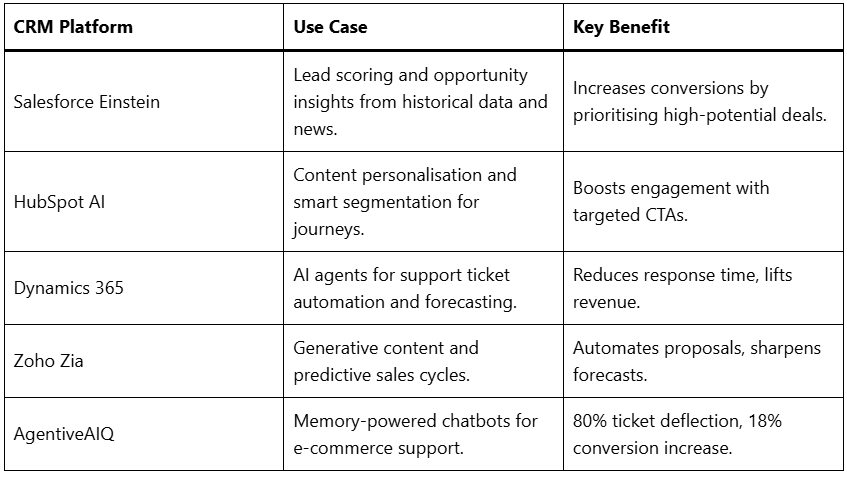
These examples demonstrate AI’s role in sectors like retail and healthcare, optimising pricing and learning paths.
Business Benefits
AI-driven CRM yields measurable gains: higher customer satisfaction via personalisation, reduced manual tasks, and revenue growth from accurate predictions. Einstein automates busywork, freeing sales teams for selling, while real-time insights cut churn.
Organizations report 2x satisfaction boosts from memory-aware interactions and 72% deflection rates. Overall, 70% of CRMs now integrate AI, driving hyper-personalisation and efficiency.
Implementation Strategies
Successful AI CRM rollout starts with data unification via CDPs, auditing for quality, and setting KPIs like 20% conversion lifts. Train teams on tools, select compatible platforms with lead scoring, and automate workflows gradually.
Pilot prescriptive features, monitor with dashboards, and ensure compliance through encryption. Hands-on training builds adoption, as seen in Einstein’s workflow injections.
Key Challenges
Data privacy risks escalate with AI accessing deep profiles, demanding strict controls to prevent breaches. Algorithmic bias skews segmentation, causing unfair strategies and reputational harm.
High costs and change resistance hinder adoption; solutions include phased pilots and user-friendly tools like CallMiner Eureka. Explainable AI addresses transparency for compliance.
Future Outlook
By 2026, autonomous agent-based CRM will dominate, with 70% featuring AI for predictive-to-prescriptive shifts. Trends include hyper-personalised marketing via single customer views and ethical, transparent models.
Expect deeper OpenAI integrations and GraphRAG for knowledge retrieval, evolving to fully agentic systems handling end-to-end relationships.