

Agentforce AI and Buybacks Shift Salesforce Outlook

The enterprise software landscape is currently undergoing its most significant transformation since the dawn of the cloud. For Salesforce, the pioneer of the Software-as-a-Service (SaaS) model, this era is defined by a high-stakes pivot toward “agentic” artificial intelligence and a massive reallocation of capital to its shareholders.
As of early 2026, the narrative surrounding the CRM giant is no longer just about cloud subscriptions—it’s about Agentforce AI and the record-breaking $50 billion stock buyback program. Together, these two pillars are reshaping the company’s outlook, balancing a bold technological vision with a disciplined financial strategy.
Table of Contents
The Rise of Agentforce: Beyond Chatbots to “Agentic” Enterprises
For years, AI in the enterprise was largely predictive or generative—it could suggest a lead or draft an email. However, Salesforce’s launch of Agentforce (and its subsequent evolution into Agentforce 360) marks a shift toward autonomous agents.
Unlike standard chatbots that require constant human prompting, Agentforce agents are designed to perform complex tasks independently across sales, service, and marketing.
Key Performance Metrics
The impact of this technology is already visible in Salesforce’s fiscal 2026 results:
- Annual Recurring Revenue (ARR): Agentforce ARR surged 169% year-over-year, reaching approximately $800 million.
- Adoption: The company closed over 29,000 Agentforce deals in its first 15 months, with customer production increasing by nearly 50% in the most recent quarter.
- The “Agentic Work Unit” (AWU): To prove the value of these agents, Salesforce introduced the AWU, a metric that tracks tasks completed by AI rather than just data processed. To date, the platform has delivered over 2.4 billion AWUs.
By positioning itself as the “Agentic Enterprise” platform, Salesforce is attempting to move the industry away from “per-seat” pricing toward “per-result” value. This is a defensive necessity: as AI makes employees more efficient, the traditional model of charging for every human user becomes a liability.
The $50 Billion Buyback: A Signal of Confidence or a Defensive Moat?
While the technology team focuses on AI, the finance department has authorised one of the largest share repurchase programs in corporate history. The $50 billion buyback, alongside a 5.8% dividend increase, serves several strategic purposes in the current market environment.
1. Counteracting “AI Anxiety”
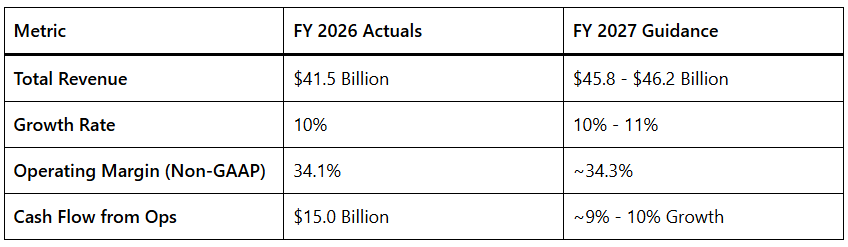
Despite record revenues of $41.5 billion in fiscal 2026, Salesforce’s stock has faced significant pressure, at one point dropping over 24% year-to-date. Investors have expressed “AI anxiety”, fearing that autonomous agents might reduce the need for large-scale software seats or that AI-native startups will disrupt legacy platforms.
The $50 billion commitment is CEO Marc Benioff’s way of saying the market is “not rational.” By returning 99% of its free cash flow to shareholders, Salesforce is signalling that it believes its stock is undervalued and its cash machine is untouchable.
2. Disciplined Capital Allocation
Critics have often accused Salesforce of overspending on “trophy” acquisitions like Slack or Tableau. The massive buyback marks a shift toward maturity. Instead of chasing unproven startups at inflated valuations, the company is betting on itself. It suggests that Salesforce doesn’t need to buy growth; it can build it through Agentforce and harvest the cash from its existing 150,000+ customers.
The Mixed Outlook: Growth vs. Headwinds
The outlook for Salesforce remains a “mixed bag” of explosive AI potential and cooling legacy demand. For the fiscal year ending in January 2027, Salesforce issued a revenue forecast of $45.8 billion to $46.2 billion. While this represents 10% to 11% growth, it was slightly below some Wall Street expectations, highlighting a “SaaSpocalypse” where companies are scrutinising every dollar of tech spend.
Long-Term Vision (2030)
Despite the near-term caution, Salesforce raised its fiscal 2030 revenue target to $63 billion. This optimism is rooted in the belief that Agentforce will not just replace old workflows but create entirely new ones. The integration of Informatica (an $8 billion acquisition completed in 2025) provides the data “plumbing” necessary to make these AI agents truly intelligent.
Strategic Challenges Ahead
The road to the $63 billion target is not without obstacles. Salesforce faces a three-front war:
- Hyperscaler Competition: Microsoft and Google are embedding AI agents directly into the operating systems and productivity suites that compete with Slack and Salesforce.
- AI-Native Disruptors: Startups are building “AI-first” CRMs from the ground up, unburdened by the legacy code or pricing models of the past.
- The “Per-Seat” Trap: If Agentforce is too successful, customers may eventually need fewer human employees, which could cannibalise Salesforce’s core subscription revenue if they don’t transition to consumption-based pricing fast enough.
Conclusion: Agentforce AI and Buybacks Shift Salesforce Outlook
The title “Agentforce AI and Buybacks Shift Salesforce Outlook” perfectly captures the dual nature of the company today. On one hand, it is a high-growth AI laboratory, launching revolutionary “vibes” and autonomous agents that redefine what a CRM can do. On the other, it is a disciplined, cash-generating titan that is returning billions to its investors to prove its long-term durability.
Salesforce is betting that the “Agentic Enterprise” is the future of work. By combining this technological leap with a record-breaking buyback, they are attempting to convince the market that they aren’t just surviving the AI revolution—they are bankrolling it.